Showing posts with label Self-awareness. Show all posts

9 Dec 2025

Where is the "I"?

In my post about the astrology and psychology of AI (August 2025), I fantasised on  what the natal chart of the birth of AI might look like, saying: 

We can forget  the presence of the Sun and Moon in this fantasy chart. The Sun represents our sense of self, personal self-awareness, ability to make decisions and moral judgements and it signifies our unique individuality. AI does not have this.....

Recently I've been listening to what Bruno Huber said about the Sun and Moon in a recorded lecture he gave on his research into medical astrology. Of the Sun, he says:

"The Sun is the “I” sense. With the Sun I am aware of myself. I feel or perceive or think about myself. 

With the Sun I don’t need any help from outside as I can perceive myself through what I think, through what I do. 

We have a tool, our ability to think and perceive; this is the Sun. I do the thinking so I must be there."

I'm choosing to write about this sense of "I-ness" as I recently saw a message (electronic, of course) from ChatGPT to someone, saying "I can give you more information on that" in response to a question.

The word "I" was used - and my response was "who or what is this I?" 

ChatGPT, and others like it, is an AI non-physical machine with no sense of self, no "I-ness". It's a disembodied collection of electrical circuits, programmed to communicate as if it were a real living, breathing person, and it can chat as if it's a real person. 

In some ways, that is a remarkable, almost magical thing which captures the imagination and attention - just think back to being a child and wishing your favourite toy could talk to you. Maybe the creators and programmers of AI had realised this when programming the machines (I gather the spaces taken up by these are very large warehouses, or similar), and tapped into it?

In some instances AI has been anthropomorphised* and given a name, as if it's a real person: for example think of "Alexa, go to Netflix", similar to chatting to a favourite doll or soft toy, but as an adult. 

And of course, the machine is programmed to be polite, friendly, helpful, non-judgemental, diplomatic etc. It's never likely to respond as a real person would - there are no nuances in it's delivery and it's not programmed to offend or upset. It doesn't disagree.

This made me pause and wonder if we have we already become so blase and familiar with AI that we don't stop and question the language it's using? Are we already regarding it as if it's an entity in it's own right?

I understand that the "humanisation" of an AI machine probably makes it sound more friendly and chummy to the user, so that the user (you or me) might feel more comfortable and at ease talking to a disembodied collection of sophisticated electronic circuits. But familiarisation with frequent use can lead, via habit and frequent use, to unquestioning acceptance that this is the "norm".

There are already instances of people who have become so attached to their AI "friend", they've regarded their interactions with it as a real relationship.

Bruno and Louise Huber developed Astrological Psychology in the 1960s. They both had Psychosynthesis training in Florence with Roberto Assagioli, while working with him at his Institute. The Astrological Psychology of the Hubers is deeply imbued with the principles of Psychosynthesis, one of which is the exploration of the sense of self.

A key psychosynthesis exercise asks the individual to explore the question "Who am I?" and it takes the person through stages of dis-identification to reach the very core of their being. The many sub-personalities we have can be identified, we can express ourselves through them, but they are not the "I" - we're more than that.

Read what I wrote about Will Parfitt's book The Journey of Psychosynthesis to find out more - and connect with your own sense of "I"- using some of the suggested exercises in the book. And relate this to the Sun in your own chart - your own sense of self, your ability to choose, make decisions and use and direct your will.

Astrological psychology is deeply imbued with the principles of psychosynthesis,  offering numerous opportunities to understand, develop your own sense of "I-ness" - something an AI machine just can't do for you.

And would you really want it to? 


* anthropomorphic - described or thought of as having a human form or human attributes.

13 May 2025

What would you like to see less of in the world?


It's very easy to identify and name what you'd like to see MORE of in the world, as I experienced when I asked this question nearly 16 years ago, and stood on the Fourth Plinth in Trafalgar Square, reading out what people wanted to see more of. 

You can read about it here and here.

But what about seeing LESS of some things in this world of ours? I ask this at a time of global upheaval and change, of war and dissent; as I write, Russia's invasion and attack on Ukraine continues after three long years of years of conflict. More recently India and Pakistan have been bombing each other over the long-standing dispute about who should "own" Kashmir, while Israel seems bent on ethnically cleansing and bombing Gaza out of existence for Palestinians.

Alongside this there are some sections of society and leaders of some countries throughout the world who appear to want a return to the rise of Fascism in the 1930s. And we know where that led. At the same time, there is a drift towards less tolerance of anything or viewpoint or lifestyle which doesn't conform to what might be regarded as the "norm". Anti-woke attitudes are touted, books are removed from libraries and words removed from the lexicon of common parlance if they are deemed to be too "woke", while infuencers spread hatred and dissent through social media.

Is this what we want? Is it the path we want to tread? The world we want our children, and their children, to inherit? Do we want it here and now, in our everyday lives?

In 2022 I wrote here about what I see as a decline in the use, expression and manifestation of transpersonal qualities in everyday life - those simple but essential things and attitudes which benefit everyone, not just one or a few of the privileged or those in positions of power. These qualities are what, in life, you can value as you recognise their worth, but you can't put a price on them. They are priceless but cost nothing, and I looked at how the energies of each of the transpersonal planets - Uranus, Neptune and Pluto - can be expressed via three levels. 

These levels apply to all planets and their expression, especially the personal planets, whose qualities and energies we express in everyday life; let's call these levels of consciousness "Asleep", "Waking" and "Awake":

 "Asleep" planetary energy is expressed through automatic survival behaviour with little or no self-awareness.

  • This what we could do with less of -  interactive human behaviours which lack empathy, where the individual is bent on its own survival and lacks self-awareness.

"Waking" behaviour comes from a place of greater awareness but is largely "me" oriented.

  • This level of increased consciousness and more aware behaviour moves in a more promising direction, but oh dear.......if it is predominatantly "me" oriented then we have the  strutting, intrusive "in your face" stuff of the "me, me" narcissist, often someone who wants to be in control. Right now the world could do with a lot less of this, especially from some world leaders.

 "Awake" behaviour is fully conscious, directed, focussed and inclusive.

  • This is what would be welcome. More of this would be most welcome - refer back to what people told me, back in 2009, when I stood on the Plinth and read out their desired shopping list of what they'd like to see more of in the world.

Then ask yourself the question: "What could I do to bring some of MORE of these qualities into the world right now, and consider how you might go about it.


Engage your Sun - your mind, your sense of self, your ability to choose, be decisive and discriminating, and use your personal will to determine what you might do. Click here for some suggestions on this.

Whatever you do doesn't have to be big or massively ambitious - it may be as simple as sharing a smile with someone or saying hello, or doing a small act of kindness - the possibilities are limitless and the positive effects will ripple outwards to counteract the tsunami of  unpleasant stuff which we'd all be better off having less of in the world right now.


23 Nov 2024

The Journey of Psychosynthesis


Astrological Psychology and Psychosynthesis go hand in. Bruno and Louise Huber, who researched and developed the Huber Method - the innovative approach to astrology that I write about here - worked alongside Roberto Assagioli, the founder of Psychosynthesis.

*  *  *  *  *

Will Parfitt’s latest book offers a comprehensive and very readable overview of Psychosynthesis. But it’s more than just a book; it’s a well-structured treasure trove of insightful practical lessons and exercises for anyone seeking to increase their self awareness and make the best choices they can as they journey through life.

Based on his work and experience of more than forty years as a psychotherapist and trainer, Will has drawn on the Psychosynthesis distance learning course he created, and he shares it in this book. The reader is guided, at their own pace, on a journey to the centre of their true self. Travelling this path, the reader – who could more appropriately be called “the explorer”, since this is a journey of discovery – is encouraged at each stage to gently open to their unique wholeness. The journey is one to be savoured, not rushed, with pauses for review and consolidation along the way.

Regardless of whether you’re new to Psychosynthesis, or are an old hand at practising this approach to self awareness, the material for this journey is well-written, clearly laid out, and presented in a relaxed and engaging style. It hits the spot. Will doesn’t talk up or down; his words speak directly from his centre. Throughout the journey, readers are encouraged to take part in the practical exercises which can be both enlightening and challenging. A break and a period for reflection is recommended at the conclusion of each lesson. The reader is encouraged to record and consolidate what they have experienced before moving on.

Life crises and turning points are focussed on, as are sub-personalities – those different parts of us - which are the diverse aspects and roles of the personality with their own individual wants and needs. One lesson covers the art of self-identification, focusing on how we do this and how it colours and influences all we encounter in everyday life. Here, Will encourages the reader to disidentify from the different roles of these sub-personalities or selves, and become the driver in their life rather than one of the passengers. There are exercises that are both challenging and empowering for anyone who has ever asked themselves “Who am I?” as it is oh-so-easy to identify with and be attached to one of our many “selves” - our sub-personalities. Learning how to connect with our core self and choose to be attached or not attached to our various sub-personalities offers the reader freedom.

On disidentification from our thoughts, feelings, roles and mental attitude, Will asserts that if we are able to disidentify from a sub-personality “we will have it rather than it having us.” On a personal level, those words resonated for me, and I will use them as a reminder and mantra when I find myself coming from a sub-personality.

The Journey of Psychosynthesis is one which will lead you to your core, your centre and your soul. If you’re a newcomer to Psychosynthesis you may want to embark on this journey and see it through sequentially from start to finish. If you’re already familiar with Psychosynthesis I can think of no better way of refreshing your perspective on whatever is going on in your life by choosing an appropriate staging post from the book and focussing on that. Will asserts that once you have the basics of Psychosynthesis, you can work with what emerges from inside, not following a pre-set plan but making the best choices you can.

You can read about how Bruno and Louise worked, studied and trained in Psychosynthesis with Roberto Assagioli in Florence in Piercing the Eggshell.


14 Aug 2024

Saturn and the art of self-preservation


This warning sign stopped me in my tracks. It was displayed in Big Bend National Park in Texas. I'd been there before and knew there were mountain lions about - but BEARS too?! That was news to me and my Saturn sub-personality immdiately focussed on safety and self-preservation as I noted all the warnings on the info board and committed them to memory. I wasn't up for taking any chances.
 
I have written about Saturn before - you can read it here -  but this time I want to look at how the qualities of this often-maligned planet can play an essential part in our own self-preservation. We may find ourselves in danger  - meeting a bear or lion or alligator on a path in a national park, we need to know the "rules" of how to manage this. The sign I saw laid these out quite clearly. That was Saturn in care-taking mode with the best interests of public safety involved, along with suggestions of how people could take responsibility for themselves.

"Rules" - there's a Saturnian word to conjure with. Depends which kind of rules they are - the restrictive, controlling "do not" type, or the more benevolent and protective guidelines, encouraging self-awareness and offering choice. You can ignore them (possibly at your peril) or take them on board and be responsible for your own safety.

 
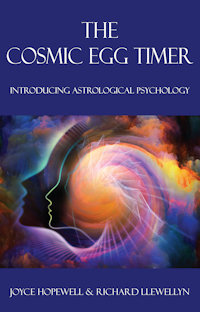
In my co-authored book, The Cosmic Egg Timer, I describe Saturn as "...the planet that swings into action when we need to know exactly where we stand - so to have social structures, guidelines and rules to abide by are all part of Saturn's realm".

Appreciating and nurturing our own Saturnian qualities can be a useful tool in keeping ourselves safe and sussing out situations which might prove a bit dodgy. Of course, there will be more than Saturn involved here if we're using our senses to judge a situation. Eyes and sight (Jupiter) will be involved, as will hearing and sound (Mercury) along with the ability to leg it/the fight-flight response (Mars).
 
As an ego planet, Saturn gives us a physical sense of self, gained through the body, which is composed of various life-supporting systems, such as the skeletal, respiratory, circulatory and digestive systems, to name just a few.

I say in my book that "The psychological drive associated with Saturn is security. Saturn is concerned with structure and form, always seeking to organise, preserve and maintain things within manageable limits.....In astrological psychology we see Saturn in a positive light. It's value should not be underestimated as it plays an essential role in our psychological make up."

Bearing in mind that, like all planets, it can operate at different levels of consciousness, at it's highest level it gives us the ability to act wisely, with dignity and maturity.
 
 
Be prepared - You may meet an alligator on a path! 


10 Jul 2024

Bittersweet


Sun, clouds and sea, Isle of Barra

In the book Bittersweet – how sorrow and longing make us whole by Susan Cain, the author explores something you might recognise immediately, just by reading the title, especially if you’re the kind of person who’s drawn to what is poignant in life. This set me thinking astrologically about which planet or planets might be associated with what is bittersweet in life, and I came up with strong possibilities for these being Moon, Venus and Neptune, but of course it doesn't stop there and readers may have their own ideas - if so, please share/comment.

In astrological psychology, the Moon represents the sense of self we gain through our feelings and emotions, and in the natal chart it can indicate how we might go about getting our emotional needs met. The Moon is also an indicator of the inner child. It can signify our spontaneous and fun-loving child-like responses, and it also acts like a mirror, reflecting what's going on around us because it can sense and pick up on atmospheres and feelings very easily. It's an important sensing tool, the part of us that feels.

Venus represents the drive to be selective and choose, using discrimination. Venus is associated with our ability to form relationships, to develop and express our aestheic tastes and preferences, to pursue what is harmonious and beautiful and, as a sensory organ, to use our physical sense of taste. The energies of Venus will be as fully engaged when you're eating a meal, as when you're visiting an art gallery, deciding on a colour scheme, listening to a piece of music or forming a new friendship. And, of course, falling in love.

Neptune notches things up to a higher and often far more inclusive level. Neptune is most likely to be the source of kindness, unconditional acceptance and non-judgemental love at its highest level - the level of mind - where "there is a desire for universal love as the highest ideal"  to quote from their book, The Planets, by Bruno and Louise Huber. 


On Neptune, they continue, "There is a heightened sensitivity and a refined awareness of communication (empathy) that breaks through all walls and flows from heart to heart.This is what Assagioli called loving understanding".

Could this be you, or me, putting this loving understanding into action and remembering to do and be this in our everyday lives? Of course, we all lapse, but if we forget about being kind, pleasant, helpful, inclusive and positive towards others, we stand in line to get an unpleasant reminder if the vitriol comes out in response! 
 
So how does this fit in with the idea of bittersweet?

Merriam-Webster’s dictionary defines Bittersweetness as

a tendency to states of longing, poignancy, and sorrow; an acute awareness of passing time; and a curiously piercing joy at the beauty of the world.”

To that I’d add yearning, the desire to be reunited with something or someone who is no longer there, or to search after an elusive goal, place or state of mind which we seek in order to feel whole, fufilled or spirit-full. Bittersweet includes both the light and the dark, exploring how the combination and meeting of sadness and joy can trigger our own creativity and open a portal to something greater than our personal selves. It can be transformative, and can be recognised as something we already “knew” when we meet it (but had forgotten about).

Bittersweet is found in sad (often beautiful) music with minor key notes…..in browsing old family photographs…..in rainy days….in intense reactions to music, art, nature and beauty, and is often accompanied by goosebumps. I’d add, based on my own experience of bittersweet, that a flash of insight, or a sudden recognition of a half-remembered, dream-like something from the past could be bittersweet too.

The book contains a short quiz to help the reader identify whether or not they are a bittersweet type, and it’s also available on line, as is her curated list of bittersweet music. You may want to try that out.

Cain shares examples of bittersweet experiences in her own life and draws on the experiences of others she meets during her thorough research for this book. She shows how a bittersweet state of mind is the quiet force which helps us transcend our personal and collective pain, whether from a death or breakup, addiction or illness. She asserts that if we don’t acknowledge our own heartache we can end up inflicting it on others, maybe through abuse, domination, or neglect. Once we realise that all humans know—or will know—loss and suffering, we can turn toward one another, rather than turn away, and connect with joy as well as sadness in a bittersweet moment.

I’ll share a couple of quotes from the book. If you read it, I hope you gain as much from it as I did:

Most of all, bittersweetness shows us how to respond to pain: by acknowledging it, and attempting to turn it into art, the way musicians do, or healing, or innovation, or anything else that nourishes the soul.

The love you lost, or the love you wished for but never had: that love exists eternally. It shifts its shape, but it’s always there. The task is to recognise it in its new form.

For more info see Susan Cain’s website


5 Apr 2024

Solar Eclipse 2024 – an astrological/psychological view


Image courtesy of NASA

In the days leading up to the 2024 eclipse, which will cover much of the USA, I’ve been pondering on how the physical eclipse – when the Sun is obscured by the Moon, from our viewpoint on Earth, along and either side of the line of totality – could be looked at from an astrological/psychological point of view.


The Sun represents the individual’s sense of self in the natal chart. The Sun is symbolic of the mind and the will, of the ability to make decisions, to take the lead, to assert oneself, to be an individual, to choose and yes – to shine and stand out in some way.The Moon represents the individual’s feelings, their emotions, the need to be loved, to have those emotional needs met, and the inner child, who might be impish or fun-loving or scared, shy and vulnerable.


If – and only if – we’re travelling along the path of personal growth and self-understanding, we’ll already be reasonably aware of our own strengths and vulnerabilities – all good Sun and Moon stuff. So shifting away from the incredible experience of physically seeing and feeling a total eclipse, and viewing it astrologically, how might it be experienced in real, everyday life when our Sun/light/sense of self is eclipsed, clouded, hidden and darkened by our Moon/feeling, sensitive/needy self?


When something happens in life where our feelings totally take over and block out our more rational mind, does our thinking go haywire? Do we have a knee-jerk emotional, irrational response, perhaps tapping into a previous traumatic event and triggering reactions similar to those we had then? If his happens, our sense of self – the Sun – takes a knock as we temporarily forget that we are OK just as we are, and that we’ve come a long way.


If this happens, it’s a personal eclipse and, unlike the real physical eclipse, it can happen any time. In a total eclipse, the Moon passes between the Earth and the Sun, blocking the Sun’s light for a short period of time. But it’s a temporary thing, and the transient experience of darkness and chill passes….as these effects can when we’re plunged into a personal life event “eclipse”.


With a real solar total eclipse, viewed from a location on Earth, there’s always plenty of notice of the event as excitement and anticipation build up ahead of the event. It’s predictable, whereas on a personal level, it may be less so if something or someone comes along, bringing experiences which swamp our sense of self and our rational mind. We forget that we can choose, can use our will (be it good will, strong will, or skilful will) to temper our emotions and ride out this temporary, personal eclipse.


Sun and the Mind

We gain a sense of self of the mind through the Sun, which, in the chart, represents our autonomous self - awareness. With its Cardinal quality, the Sun is our drive to be assertive, go-ahead and initiatory. The Sun is the sense of self we gain through our ability to make decisions and use the mind. It’s our capacity to choose, our capacity to make conscious choices and ultimately take responsibility for ourselves.

Whichever role you cast it in, it represents how we direct and use our will based on the decisions we make. It leads the way, and the rest of the planets, our psychological drives, follow. The Sun signifies our strength and power and this is involved when we discriminate and judge, when we think, form ideas and tap into our innate creativity. 

 The Sun, the sense of self and the will   

Closely linked with the Sun is the use of the will. We can draw on

 · our strong will which gives us determination and the capacity to keep going

 · our skilful will which endows us with sound common sense and the ability to be flexible and adaptive as we work towards our goals, and

 · and our good will which enables us to include others and to work selflessly for their benefit as well as our own.

The use of the will helps us to be goal-oriented and better able to go after what we want to achieve.

When we’re seeking to achieve the goals we set ourselves, it’s useful to remember that energy follows thought. Using the Sun/mind, we form our ideas and go on to make these real, to make them manifest. Doing so, we can be truly creative.

Our capacity to use our will, to be aware that energy follows thought and to find practical grounding in our everyday lives for our ideas and creativity can be developed and should be encouraged. It can help us strengthen the Sun and gain a greater, more centred self-confidence, and ride out the temporary effects of a personal “eclipse”.

2 Dec 2023

The Second Time Around

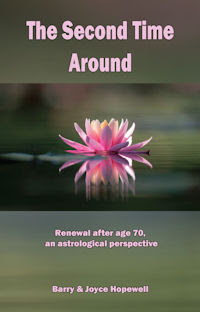
Two years in the researching and writing, my new book, co-authored with Barry Hopewell, was published in early December.

Overview of The Second Time Around

The years from age 70 onwards do not necessarily have to be years of gradual decline. In truth, no-one relishes the thought or the reality of getting old, but The Second Time Around does throw some positive light on the subject.

The Age Progression of Bruno & Louise Huber’s astrological psychology tells us that age 70 and beyond is a favourable time for growth and renewal of our lives, as we begin to circle around the Life Clock of the birth chart for the second time. From birth, we move around the natal chart in psychological and developmental steps and stages, each taking 6 years. We develop, grow and learn from our life experiences at each step of the way.

On reaching age 70 - and depending on how self-aware we are -  we have the opportunity to move beyond the limitations which we may have had since childhood or our adult years.

The research documented in the book is aimed to validate the theories of the Hubers, regarding the Life Clock and the realities of life at age 70+. We include the real life stories of 25 practitioners and non-astrologers, including their reflections relating their charts to key psychological events of their lives. We also relate the Huber theories to the understanding of other astrologers and psychologists.

It seems that at this stage of life we face a choice. We can continue to learn from past experience and grow in a spiritual direction towards wisdom, or we can stay at the same kind of psychological and developmental level we were at in our earlier lives, perhaps begrudging the inevitable slow decline in our faculties.

If we choose the former path some sort of Life Review can help us find our way to
renewed life. Astrological psychology, the birth chart and use of the Life Clock can very
much help us in this process, enabling us to identify and move beyond habitual patterns and obstacles to growth.

The Second Time Around is available from booksellers and Amazon.


Publication Details

Paperback, 192 pages. First published 4th December 2023 by HopeWell, Knutsford, England.
ISBN: 978-0-9956736-7-0


6 Oct 2022

Rose of Heaven

                    Rose of Heaven 

          and other stories by Will Parfitt


I confess to not being a fan of short stories, always finding them, as a child and teenager, like a taster or snack, and never as satisfying as the full-blown meal of a novel. My view towards them changed when I learned that short story writing is a specific and exacting art, so with this in mind – and with an open mind too - I read Rose of Heaven and the other eight short stories in Will’s latest book.

I wasn’t disappointed. Far from being light snacks, each one comes with a meaty message elegantly seasoned with positive and/or thought-provoking ideas. Will draws on his experience of working for many years as a psychotherapist, and his own search for truth and meaning. The stories all have a psychological slant, which may or may not hit the spot, depending on where the reader is on their own life path

Characters come across as real, and there is a gentle touch of humour in several stories. Nothing Like a Hole in the Head had me intrigued and made my toes curl at the same time. It’s probably the one story which impressed me most, along with

Mabel’s Mindfulness, which made me smile, has a feel-good quality and an interesting punchline. The title story, Rose of Heaven, is possibly based on the author’s personal experiences and searches. It sets the scene, signalling (to me at any rate) that the reader will be in good hands in this book. “I love you for who you are, not what you do…..” says Rose to the anonymous character who is telling the tale.

I will return to read Rose of Heaven and the other stories at a later date. I suspect there is a mirror hidden in each and every one of them which will offer me insights and encourage reflections and connections.

Recommended reading? Yes!


Will Parfitt is the author of several non-fiction books on psychology and psychosynthesis. 

His most recent book, "The Magic of Psychosynthesis", is reviewed here on this blog.

This book and "Rose of Heaven" are available on Amazon.

9 Jun 2022

Planetary manifestations


How do the energies and characteristics associated with the personal planets act out in everyday life? How is this energy expressed? We can observe it in human behaviour  - that of others and in our own responses to life situations.

Let's look at how it might show up, bearing in mind that the energies of the planets can operate at several different levels, ranging from downright low levels to more admirable and acceptable higher manifestations.

Starting with the Sun - our sense of self, which can always do with a polish up from time to time to keep it on the higher level - consider how you're feeling about yourself today, right now. Are you reasonably centred, focussed, clear in your mind about what you're doing? Are you willingly taking responsibility for yourself and the decisions you make?

Next check out the Moon. How are your feelings and emotions and needs? Is the small child in you acting up in any way? Can you give your feelings some attention or do you push them down, ignore them and hope they'll go away? Is there anything you can do right now to help with this?

What about Mercury? How are your communications with yourself (like the needy Moon)? And how are your communications with others? Are they good, clear, not muddled and well-expressed, or do you avoid straight talking? Do you pore over news websites to keep up with what's going on, or talk/WhatsApp a lot with friends? What are you reading or learning about right now?

Engaging with Venus, we can connect with the higher levels of beauty through the arts; on the lower levels we might just stuff ourselves full of food and become sluggish. Taking things up a few notches, we will be considerate to those around us, engage with our sense of taste in all areas of life, and strive for more harmony with our family and friends.

If we don't engage with Mars, nothing will get started and nothing will be achieved. Depends how you, and every individual, make the energies of this planet manifest. Argumentative, combative, controlling, bullying behaviour come across as pretty low down on this planet's possibilities but, directed skilfully and with awareness, it can be notched upwards and used as an impressive force to get things done, such as those small tasks we prefer to ignore and leave hanging around.

Jupiter is engaged when we step out of the ordinary and take a risk, and do something new or different, like eating a new dish, or going to a new place. We can all do something we've never done before, and it doesn't have to be outrageous (although Jupiter is not known for holding back as it's the master of grand gestures). You don't have to try bungee jumping, just temper whatever boundary of experience you want to extend with a little common sense, which takes us on to.....

Saturn who may be regarded by some as the killjoy of the cosmic group, but is essential to keep things within safe bounds on a personal as well as a general level. How do you structure your time, your day, your life? Saturn is on call here and fulfils the need we all have for stability and security - but keep this in perspective and don't let your saturnian tendencies hold you back. Proceed with caution and awareness and be thankful you have this capacity to keep yourself safe.

The Planets by Bruno and Louise Huber offers a lot more insight and info on these personal planets, and I recommend it as an excellent source of all you need to know to get you started on understanding how you and your planetary manifestations operate.


1 Apr 2022

Moon Node chart

The Moon Node Chart is unique to the Huber Method, and is one of the three charts used in Astrological Psychology. The other two are the Natal Chart (used by all astrologers) and the House Chart, which I've previously written about. You can find out about the House Chart here.

The Moon Node Chart can be likened to a mirror - we can look into it to discover more about the shadow side of the personality, those things which might be repressed and that we don't like in ourselves, and it can also reveal to us the accumulated knowledge and life experience we bring with us to this lifetime.

Moon Node Chart


The Moon Node Chart shown here reflects the aspect patterns and shaping shown in the Natal Chart below.

The orientation of the aspect structure in the chart is different. In the Moon Node Chart it has a more vertical direction, and in the Natal Chart below, it's more focussed on the horizontal. This is significant.


Natal Chart

Also note that the positions of the planets are reversed, giving the mirror image effect, which makes looking at the Moon Node Chart rather like looking into a mirror, where what is seen is not really there.

The Moon Node Chart is always used alongside the Natal Chart and never on its own. The two are designed to be used together, and this particular technique was researched extensively by Bruno Huber. It can offer insights, for those who are on a path of self-growth and awareness, into where they are coming from. It can also highlight some of their more habitual patterns of response to everyday life - the well-used behaviour patterns. The beauty of understanding and working with this chart is that it can help us to see what is going on in ourselves, decide if we want to keep it or make changes, and then actively and consciously choose to leave our familar and habitual patterns of response and behaviour behind us and move on.

Finding out more about the Moon Node Chart

There are several ways of doing this:
  • Read Moon Node Astrology by Bruno & Louise Huber (see sidebar). It offers comprehensive coverage of this specific and unique chart. Click on Books by the Hubers in the bar at the top of this page
  • Read The Living Birth Chart which specifically features using the Moon Node Chart and gives worked examples using the charts of real people. Click on  Books by Joyce Hopewell in the bar at the top of this page
  • Have a consultation with an astrologer trained in Astrological Psychology. They will really know their stuff and will treat you and your Moon Node Chart with the greatest respect, as use of the Moon Node Chart is not to be taken lightly.  
  • Louise Huber says that when we look into the Moon Node Chart, we have to be completely harmless. This should always be borne in mind when working with this chart.


3 Dec 2021

Friendship, Fun and Folly in the Fifth House

The astrological houses sometimes cause a bit of confusion for non-astrologers, because people don't know what the houses are, but if you substitute the words "area of life experience" for "house" that will give you a better understanding of what they mean in a real life context.

To find out which areas of life experience each house represents take a look at my my co-authored book The Cosmic Egg Timer and my YouTube channel where I describe what each house  - including the fifth house  - represents.

The fifth house is one which most people can readily understand as it's concerned with relationships, the friendships we make and the experiences and real life lessons - both good and bad -  that we gain from them.

 Quoting from The Cosmic Egg Timer, I say that

The 5th house is, in a sense, a place of self-discovery. This is an area where we venture forth from the collective to explore ourselves in contact with the world and participate in the Games People Play. It is an extrovert place where we are likely to be full of self-belief, flamboyance and even bravado as we go out on our journey of conquest. We like to be involved with people, have a good time, and our conquests may well involve the opposite sex; these may produce the other aspect of this house – creativity, whether this be babies or works of art.

The downside in this area of life is that when our conquests don’t produce the results we need to make us feel special, we feel rejected and insecure. We may attempt to possess somebody and hold him/ her as a personal prize in order to prove how good we are. 

Musing on this, alongside my own life experiences in this house/area of life, I consider myself lucky to have true friends, people I trust. I've known some of them for years. But there have been others along the way who initially presented themselves as friends, but turned out not to be so, and were not to be trusted. In this way, the fifth house can be a learning ground, filled with real life experiences which are not always pleasant, but which offer important lessons for self understanding and personal growth.

Friendship and fun with a true friend is something to treasure and cultivate. Friends can laugh together, do things together, trust each other and share confidences. A friend will support you, stay in touch, be there if you're going through a difficult time, remember your birthday, be kind to you, be honest with you, and not talk behind your back. And you can reciprocate by doing the same for them. It's a two-way traffic and you're equal partners.

Folly creeps in when someone purporting to be a friend proves to be anything but. You might blame yourself for being taken in by this person, for being taken for a fool, especially when you realise that this is a toxic relationship and you're being used, manipulated and controlled. You've been drawn into playing one of the many games people play in the arena of relationships. This is especially so where powerful emotions are involved, and your so-called friend -  or maybe it's your ex - proves unworthy of your trust and reveals their true colours.

Of course, the boot could also be on the other foot and you may realise that you could be the one attempting to possess or control somebody and hold him or her as a personal prize in order to gain power over them or prove something to yourself.

By waking up and being consciously aware of our own motivation and behaviour with the friends we relate to in this area of life we can, thankfully, begin to bypass the downside of these games - such as control and manipulation - and create lasting and worthwhile connections which are true, open, honest and beneficial to all concerned.

In fifth house friendships, as in all areas of life, there's always a choice between  the darker alleyways and the path of light.


16 Nov 2021

Decisions and choices

My book The Living Birth Chart is a practical workbook which includes theory, chart examples and practical exercises for the reader/seeker to dabble in and enjoy the revelations they provide. It's a book to dive into and use if you want to bring your natal chart to life and apply what you discover to your everyday life. It's also about becoming more self aware and being responsible for yourself and the actions and decisions you make.

Now, I happen to think that achieving and maintaining autonomy and taking responsibility for ourselves is not easy. It’s something which we can always improve upon, wherever we are along this particular path, and sometimes we need to have a refresher and brush up on our skills in this department of everyday life.

Some time ago I heard a radio interview with one of the authors of a book called “Mistakes were made (but not by me)” * about why we justify foolish beliefs, bad decisions and hurtful acts - declining, wherever possible, to take responsibility for something which we’ve chosen to  do. 

Whether or not our choice was wise, foolish or misguided is not the point; the issue is our reluctance to take responsibility for the choice we made and the part we played.

As far as The Living Birth Chart is concerned, it’s always been my experience that the very best way to learn and understand astrology from a deep level is to make it come alive in ways that we can relate to on an everyday basis. It’s possible to learn astrology in an intellectual way, using our Mercury function of gathering and accumulating facts and information. But when we engage with Jupiter and use our eyes and our senses, and relate what we’re seeing, hearing, touching, perceiving to real life experiences, that’s when astrology truly comes alive and is for real.

When astrology becomes an integral part of your life on a day to day basis it begins to live - and you do too -  with a sharpened focus as you become more consciously aware, which means in turn that you begin to live in a more responsible way.

The point I’m moving towards here relates to the importance and significance of being autonomous and taking responsibility for ourselves and our actions, together with the capacity to recognise and honestly acknowledge when we’ve got something wrong. The converse is equally true, because if we’re really autonomous and self-aware we can quietly acknowledge when we’ve got something right without needing to crow or gloat about it.

One of the key features of astrological psychology as a tool for personal growth is that it places taking responsibility for ourselves, our lives and what goes on within them into our hands, and our hands alone, so it becomes more difficult to blame anyone else if things go wrong.

Using the birth chart as a tool in this way, we find it offers us choices. Once we’re aware that we can exercise choice in our everyday lives, things are unlikely to be the same again because we’ll be responsible for the direction our life takes, and no-one else!

An important way of working towards this greater wholeness can be achieved by developing and using the Sun, which can be likened to the conductor of our orchestra of planets and psychologival drives -  or as I sometimes like to think of it -  the leader of our jazz band!

However you wish to see the role of the Sun, it’s a very significant planet which is involved in the development of our sense of self, our autonomy, our ability to take responsibility - and as well to accept that yes, we do sometimes make mistakes!

The Sun is a Cardinal planet expressing Cardinal energy. It embodies the drive to assert and create, and it is important that this part of us is developed and strengthened so that it can be expressed clearly and without fear. It shouldn’t be hidden away like a bright torch under a damp blanket, but allowed to shine and be seen.

Sun and the Mind

We gain a sense of self of the mind through the Sun, which, in the chart, represents our autonomous self - awareness. With its Cardinal quality, the Sun is our drive to be assertive, go-ahead and initiatory.

The Sun is the sense of self we gain through our ability to make decisions and use the mind. It’s our capacity to choose, our capacity to make conscious choices and ultimately take responsibility for ourselves.

Whichever role you cast it in, it represents how we direct and use our will based on the decisions we make. It leads the way, and the rest of the planets, our psychological drives, follow. The Sun signifies our strength and power and this is involved when we discriminate and judge, when we think, form ideas and tap into our innate creativity. 


The Sun, the sense of self and the will   

Closely linked with the Sun is the use of the will. We can draw on

 · our strong will which gives us determination and the capacity to keep going

 · our skilful will which endows us with sound common sense and the ability to be flexible and adaptive as we work towards our goals, and

 · and our good will which enables us to include others and to work selflessly for their benefit as well as our own.

The use of the will helps us to be goal-oriented and better able to go after what we want to achieve.

When we’re seeking to achieve the goals we set ourselves, it’s useful to remember that energy follows thought. Using the Sun/mind, we form our ideas and go on to make these real, to make them manifest. Doing so, we can be truly creative.

Our capacity to use our will, to be aware that energy follows thought and to find practical grounding in our everyday lives for our ideas and creativity can be developed and should be encouraged. It can help us strengthen the Sun and gain a greater, more centred self-confidence. We can aim to be devoid of ego needs or the urge to prove that we are “the greatest”. 

And let’s face it - if we’re on a spiritual path, this attitude is pretty much redundant!


The Living Birth Chart is published in full colour. Click on the link for more info, and read a review of the book here.


* "Mistakes were Made (but not by me)" by Carol Tarvis and Elliot Aronson. pub. Harcourt Books