Showing posts with label Book extract. Show all posts

12 Apr 2025

Power, Pluto, and Symptoms of Megalomania

In their book, The Planets and their Psychological Meaning, Bruno and Louise Huber share their insights into the planets and associated observable patterns of human behaviour for each planet. They describe behaviours being expressed at three different levels, or stages:

At stage 1, the person will be largely unaware and attached to matter and what is  material; it's what they call a "blind stage" as far as awareness is concerned.

At stage 2, the person's emotional responses are engaged, often resulting in a polarity, an opposition, and of learning the difference between positive and negative.

At stage 3, the person is able to discriminate and form accurate judgements as a greater self-awareness kicks in. In a nutshell, it's all about growing and developing awareness of self and ultimately, of others.

I share this in light of the current global situation where a tariff war, affecting trade and stability in just about every country in the world, was started on 2nd April 2025 by the 47th president of the United States. You can see his chart here.

The Hubers outline manifestations of each of the planets used in Huber-style charts at these three stages. For manifestations of Pluto (for without a doubt, that is the flavour of the energies the current incumbent at the White House is engaging with and expressing) they suggest:

"Masks, egomania, use of power, imposing the will, destructiveness, stirring up of what is suppressed, crises" for stage 1

"Megalomania, drivenness......" are among their suggestions for stage 2, and for stage 3, where discrimination, fairness, self-awareness and a loosening of the individual's ego needs are more evident, they suggest "...effective power, making a creative contribution to evolution".

But let's stay with stage 1 for now, because it seems to dominate the observable behaviour, responses, language and general demeanour of this 47th president. Hardly a day goes by without more jaw-dropping news of further heavier tarrifs for some countries, while others appear to be getting an easy ride. Like a yo-yo bouncing up and down, the parameters, boundaries and rules are switched on and then off.

It's an object lesson in power and ego-ridden behaviour, where things are changed, seemingly on a whim, and if there is criticism within the inner circle, heads roll as people are dismissed. Like the Queen of Hearts in Alice in Wonderland, who is childish and quick to give death sentences at even the slightest of offences, numerous news reports echo  this aspect of the president's behaviour.

In The Planets the Hubers go further. Examples they give of stage 1 Pluto behaviour are here, and  I quote:

"Pluto is always involved in problems of power. One calls for an unlimited reach of power, believing oneself to be the best, the greatest and the only one who is right. In the case of hardened ego powers this gives rise to megalomania or egomania, where a person thinks only he is right and everyone else is a novice.....A lack of consideration for the demands of others and ruthlessness are the unpleasant side of Pluto on this level. All its efforts are mobilised, it fights like one possessed for its property, status and power. Anyone who wants to contest this power will be labelled an enemy who must be go rid of."   (Extract from The Planets, p.89, B&L Huber)

In terms of Age Progression, the 47th president's Age Point is currently in the 2nd house for The Second Time Around (click for more info on this) He's 78, and in terms of Age Point, has re-entered  the phase of life first encountered at ages 6 to 12 years. 

Between the ages of 6 and 12, the child establishes him/herself amongst peers, creating a sphere of personal possessions. In the 2nd house the child defines and defends his/her territory and possessions, which may determine behaviour in later life. Whereas at ages 6 to 12 the 2nd house  is about gathering and hanging on to possessions, at ages 78 to 81, it's about letting go.

A final thought/quote, in this post which attempts to throw some light and astrological-psychological understanding on current events and the person driving them:

"This house is about letting go, but the 2nd house can also reignite a preoccupation with material possessions. Those of a materialistic frame of mind surround themselves with material possessions; become tight-fisted, unwilling to part with anything. They are scared of being short-changed.....become jealous and take all possible precautions lest anyone deprive them of anything."  (Extract from The Second Time Around, p.15, J&B Hopewell. See also The Planets, p.251)


14 Aug 2024

Saturn and the art of self-preservation


This warning sign stopped me in my tracks. It was displayed in Big Bend National Park in Texas. I'd been there before and knew there were mountain lions about - but BEARS too?! That was news to me and my Saturn sub-personality immdiately focussed on safety and self-preservation as I noted all the warnings on the info board and committed them to memory. I wasn't up for taking any chances.
 
I have written about Saturn before - you can read it here -  but this time I want to look at how the qualities of this often-maligned planet can play an essential part in our own self-preservation. We may find ourselves in danger  - meeting a bear or lion or alligator on a path in a national park, we need to know the "rules" of how to manage this. The sign I saw laid these out quite clearly. That was Saturn in care-taking mode with the best interests of public safety involved, along with suggestions of how people could take responsibility for themselves.

"Rules" - there's a Saturnian word to conjure with. Depends which kind of rules they are - the restrictive, controlling "do not" type, or the more benevolent and protective guidelines, encouraging self-awareness and offering choice. You can ignore them (possibly at your peril) or take them on board and be responsible for your own safety.

 
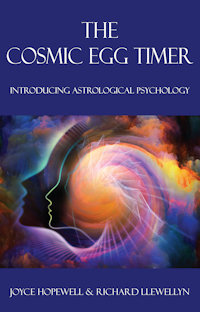
In my co-authored book, The Cosmic Egg Timer, I describe Saturn as "...the planet that swings into action when we need to know exactly where we stand - so to have social structures, guidelines and rules to abide by are all part of Saturn's realm".

Appreciating and nurturing our own Saturnian qualities can be a useful tool in keeping ourselves safe and sussing out situations which might prove a bit dodgy. Of course, there will be more than Saturn involved here if we're using our senses to judge a situation. Eyes and sight (Jupiter) will be involved, as will hearing and sound (Mercury) along with the ability to leg it/the fight-flight response (Mars).
 
As an ego planet, Saturn gives us a physical sense of self, gained through the body, which is composed of various life-supporting systems, such as the skeletal, respiratory, circulatory and digestive systems, to name just a few.

I say in my book that "The psychological drive associated with Saturn is security. Saturn is concerned with structure and form, always seeking to organise, preserve and maintain things within manageable limits.....In astrological psychology we see Saturn in a positive light. It's value should not be underestimated as it plays an essential role in our psychological make up."

Bearing in mind that, like all planets, it can operate at different levels of consciousness, at it's highest level it gives us the ability to act wisely, with dignity and maturity.
 
 
Be prepared - You may meet an alligator on a path! 


10 Jul 2024

Bittersweet


Sun, clouds and sea, Isle of Barra

In the book Bittersweet – how sorrow and longing make us whole by Susan Cain, the author explores something you might recognise immediately, just by reading the title, especially if you’re the kind of person who’s drawn to what is poignant in life. This set me thinking astrologically about which planet or planets might be associated with what is bittersweet in life, and I came up with strong possibilities for these being Moon, Venus and Neptune, but of course it doesn't stop there and readers may have their own ideas - if so, please share/comment.

In astrological psychology, the Moon represents the sense of self we gain through our feelings and emotions, and in the natal chart it can indicate how we might go about getting our emotional needs met. The Moon is also an indicator of the inner child. It can signify our spontaneous and fun-loving child-like responses, and it also acts like a mirror, reflecting what's going on around us because it can sense and pick up on atmospheres and feelings very easily. It's an important sensing tool, the part of us that feels.

Venus represents the drive to be selective and choose, using discrimination. Venus is associated with our ability to form relationships, to develop and express our aestheic tastes and preferences, to pursue what is harmonious and beautiful and, as a sensory organ, to use our physical sense of taste. The energies of Venus will be as fully engaged when you're eating a meal, as when you're visiting an art gallery, deciding on a colour scheme, listening to a piece of music or forming a new friendship. And, of course, falling in love.

Neptune notches things up to a higher and often far more inclusive level. Neptune is most likely to be the source of kindness, unconditional acceptance and non-judgemental love at its highest level - the level of mind - where "there is a desire for universal love as the highest ideal"  to quote from their book, The Planets, by Bruno and Louise Huber. 


On Neptune, they continue, "There is a heightened sensitivity and a refined awareness of communication (empathy) that breaks through all walls and flows from heart to heart.This is what Assagioli called loving understanding".

Could this be you, or me, putting this loving understanding into action and remembering to do and be this in our everyday lives? Of course, we all lapse, but if we forget about being kind, pleasant, helpful, inclusive and positive towards others, we stand in line to get an unpleasant reminder if the vitriol comes out in response! 
 
So how does this fit in with the idea of bittersweet?

Merriam-Webster’s dictionary defines Bittersweetness as

a tendency to states of longing, poignancy, and sorrow; an acute awareness of passing time; and a curiously piercing joy at the beauty of the world.”

To that I’d add yearning, the desire to be reunited with something or someone who is no longer there, or to search after an elusive goal, place or state of mind which we seek in order to feel whole, fufilled or spirit-full. Bittersweet includes both the light and the dark, exploring how the combination and meeting of sadness and joy can trigger our own creativity and open a portal to something greater than our personal selves. It can be transformative, and can be recognised as something we already “knew” when we meet it (but had forgotten about).

Bittersweet is found in sad (often beautiful) music with minor key notes…..in browsing old family photographs…..in rainy days….in intense reactions to music, art, nature and beauty, and is often accompanied by goosebumps. I’d add, based on my own experience of bittersweet, that a flash of insight, or a sudden recognition of a half-remembered, dream-like something from the past could be bittersweet too.

The book contains a short quiz to help the reader identify whether or not they are a bittersweet type, and it’s also available on line, as is her curated list of bittersweet music. You may want to try that out.

Cain shares examples of bittersweet experiences in her own life and draws on the experiences of others she meets during her thorough research for this book. She shows how a bittersweet state of mind is the quiet force which helps us transcend our personal and collective pain, whether from a death or breakup, addiction or illness. She asserts that if we don’t acknowledge our own heartache we can end up inflicting it on others, maybe through abuse, domination, or neglect. Once we realise that all humans know—or will know—loss and suffering, we can turn toward one another, rather than turn away, and connect with joy as well as sadness in a bittersweet moment.

I’ll share a couple of quotes from the book. If you read it, I hope you gain as much from it as I did:

Most of all, bittersweetness shows us how to respond to pain: by acknowledging it, and attempting to turn it into art, the way musicians do, or healing, or innovation, or anything else that nourishes the soul.

The love you lost, or the love you wished for but never had: that love exists eternally. It shifts its shape, but it’s always there. The task is to recognise it in its new form.

For more info see Susan Cain’s website


3 Feb 2024

The Second Time Around - some thoughts on moving from role to soul


"The Inner Work of Age - shifting from Role to Soul" formed part of the research for my recent co-authored book, The Second Tme Around, looking at life beyond age 70+, and the opportunities this phase of life brings for renewal.

It was a book I could relate to, understand and learn from. Not only was it an excellent read, it was a nudge and a reminder of things I'd forgotten. It flagged up things I'd either been mulling over or had received sudden insights about, and is featured in Chapter 3 - What other authors say about this stage of life, in The Second Time Around.

Author Connie Zweig, a retired psychotherapist, draws on her personal experience of being an Elder alongside her professional work with others, also Elders, travelling the path from role to soul. She likens Elders to teachers or mentors, those who willingly pass on the wisdom of their life experience, not from a place of ego, or of needing recognition for their know how, but simply because they are at ease with themselves just as they are and don't need to prove anything, or be how others might "expect" them to be.

Zweig suggests that as Elders, behaving in this way, give hard-won knowledge to the next generation, welcoming a new generation of seekers and agents of change. The ego is set aside; it has no place when role or roles, which might have defined us during our more active working life, are dropped as the essence of soul begins to find it's place.

Whilst reading the book and reviewing my own status as Elder (yes, I'm old enough for this) I had some significant, transformative experiences and insights as I'd been evaluating myself and my relationships, contacts and friendships – their value, importance and permanence. I examined the depth, richness and quality of my current interactions with others, and realised that I’d become far more selective and discriminating about who I choose to spend time with. No longer willing to waste time or energy or pussyfooting about with relationships which don't hit the spot for me, I’m far more comfortable now being straight, truthful and outspoken.

In this Elder phase of life, I’m far more perceptive and discriminating about who I can trust and who I can’t. As for my "role", I'm not really clear if I now have one. Yes, I'm a retired teacher and as such I can always seize what is called "the teachable moment" with children and adults alike, but retired it's a lot easier being a volunteer in the classroom rather than being in charge.

I’ve made personal and psychological changes to myself and my outlook over the past couple of years, and I’ve questioned what my role, if any, is meant to be – or if I even need a “role”. Volunteering is one way Elders shift from role to soul - they become more involved in sharing their skills and knowledge and energy in society, for the benefit of others. And of course, they get a lot back from doing so, quietly being themselves and not needing the ego boost.

23 Jan 2024

Age Point echoes - 36 and 72 years

While researching my recent co-authored book - The Second Time Around - a number of contibutors to the book, who were sharing their own experiences of the Age Point moving around the chart for the second time, noted the "Echo Effect".

At age 36, the hand of the LifeClock crosses the DC and, like sunrise waking the earth at the start of the day, we "wake up" to a new perspective on life. Some people speak of finding this age and time of life like being "halfway there" (maybe to old age?) but many people experience an increased sense of maturity and a deeper understanding of their place in the world at age 36.

Even with no astrological knowledge, this age and period of life can feel significant and meaningful; people have described it as a time of waking up to the possibility of new horizons. There is an insight into the immensity of what this next stage of life can offer - I've heard it described by clients who recognised this time as the "world is my oyster" moment.

An echo effect is at work with the 36 year point of the cycle and it's second stage, the next 36 years, leading to one circuit of the circular chart at age 72. Sigificant psychological events that happened in childhood, or between ages 36 and 42, can ping back into consciousness as they are revisited from a new perspective at 36 years or 72 years later.

The 72 year period seems to be of particular significance as we re-enter the 1st house/area of life experience. We're there, literally, for the second time around and we have the first opportunity to experience consciously the energies and events encountered in early childhood, at a time when we had no possibility of assimilating potentially traumatic experiences.

Memories and echoes of this past, or from 36 years earlier, of events we experienced - good or bad, beneficial or painful - surface. Unresolved issues may demand attention and, with the wisdom of life experience to draw upon, it's possible - with some willing work on our part – to clear these. There may be insights, understandings, new perspectives, forgiveness and letting go of things from the past which are no longer relevant of useful – especially if we’re on an upward spiral and a spiritual path.

T.S.Eliot says it far better than I can, and in fewer words:

What might have been and what has been point to one end, which is always present. Footfalls echo in the memory down the passage which we did not take towards the door we never opened…..

Time past and time future, what might have been and what has been point to one end, which is always present.

Four Quartets: Burnt Norton


2 Dec 2023

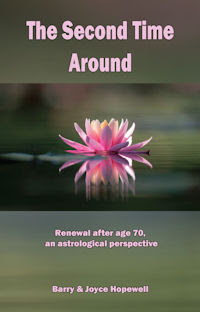
The Second Time Around

Two years in the researching and writing, my new book, co-authored with Barry Hopewell, was published in early December.

Overview of The Second Time Around

The years from age 70 onwards do not necessarily have to be years of gradual decline. In truth, no-one relishes the thought or the reality of getting old, but The Second Time Around does throw some positive light on the subject.

The Age Progression of Bruno & Louise Huber’s astrological psychology tells us that age 70 and beyond is a favourable time for growth and renewal of our lives, as we begin to circle around the Life Clock of the birth chart for the second time. From birth, we move around the natal chart in psychological and developmental steps and stages, each taking 6 years. We develop, grow and learn from our life experiences at each step of the way.

On reaching age 70 - and depending on how self-aware we are -  we have the opportunity to move beyond the limitations which we may have had since childhood or our adult years.

The research documented in the book is aimed to validate the theories of the Hubers, regarding the Life Clock and the realities of life at age 70+. We include the real life stories of 25 practitioners and non-astrologers, including their reflections relating their charts to key psychological events of their lives. We also relate the Huber theories to the understanding of other astrologers and psychologists.

It seems that at this stage of life we face a choice. We can continue to learn from past experience and grow in a spiritual direction towards wisdom, or we can stay at the same kind of psychological and developmental level we were at in our earlier lives, perhaps begrudging the inevitable slow decline in our faculties.

If we choose the former path some sort of Life Review can help us find our way to
renewed life. Astrological psychology, the birth chart and use of the Life Clock can very
much help us in this process, enabling us to identify and move beyond habitual patterns and obstacles to growth.

The Second Time Around is available from booksellers and Amazon.


Publication Details

Paperback, 192 pages. First published 4th December 2023 by HopeWell, Knutsford, England.
ISBN: 978-0-9956736-7-0


13 Dec 2021

The Four-Fold Way

Some time back in the 1990s I came across the Four-Fold Way, which was referred to at a personal growth workshop I attended. The Four-Fold Way was attributed to anthropologist Angeles Arrien, and I was impressed by it’s four simple points of wisdom:


· Show up and choose to be present

· Pay attention to what has heart and meaning

· Tell the truth without blame of judgement

· Be open to outcome, not attached to outcome


This led me to read her book, entitled The Four-Fold Way - Walking the Paths of the Warrior, Teacher, Healer and Visionary. The book, its content and ethos have come back to mind right now. The times we are currently living in are full of change and divisions within society. Climate breakdown is not new, but the need to take on board and address the problems we're making for ourselves and future generations now have to urgently be addressed.

It's time for us all to start taking responsibility for ourselves and stop moaning.

Angeles Arrien suggests four paths we might take, and her opening sentence, way back in 1992 when the book was published, is pressingly relevant today. She says,

"Today it is imperative that we pay attention to ecological issues. Our planet, the house we live in, is in danger of becoming unliveable, due primarily to the neglect of our own industrialised society. It is clear we need to take action before it is too late."

She goes on to say that the word ecology comes from the Greek word oikos, which means house, in other words our "house", our planet.

The four ways she describes can be shown diagrammatically using the medicine wheel layout and includes the four points of the compass, and the four elements of fire, earth, air and water. Each Way has a single line description which more or less lays out what it's about.

The Way of the Warrior - Show up and choose to be present- the message here is to stip dillydallying about and do something, take action. The associated human resource is power, the way of living is right action.

The Way of the Healer - Pay attention to what has heart and meaning - this suggests don't allow yourself to get distracted (by smart phones, social media etc?) but remain in touch with what is really important and connected to your heart. The associated human resource is, unsurprisingly, love; the way of living is right speech.

The Way of the Visionary - Tell the truth without blame or judgement - here we have to remember to speak our own truth, be true to ourselves, and not take on board what others have tried to foist upon us. This can be a tough one as it's much easier to go along with things we don't really agree with in order to fit in, or keep the peace. And we have to remember not to blame or judge ourselves and others. The associated human resource here is vision, and the way of living, right placement.

The Way of the Teacher - Be open to outcome, not attached to outcome - the message is to stay open to the new and not have an end goal in mind. A good teacher will always be open to new ideas and viewpoints because so much fruitful material can come from staying open and learning more. Good teachers are always learning! The associated human resource is wisdom and the way of living is right timing.

Angeles Arrien’s work as an anthropologist, educator and facilitator of workshops aims to build a bridge between cultural anthropology, psychology and comparative religions, revealing how indigenous wisdoms are relevant to our families, professional lives and our relationship with the Earth itself. There is something in The Four-Fold Way for all who wish to develop themselves, their potential and their ability to live life creatively, and we need this approach more than ever right now, in our current times.

“Do all the good you can, with all the means you can, in all the ways you can, to all the people you can, as long as you can” - Angeles Arrien.


30 Oct 2021

Fred Astaire: "Can't act. Slightly Bald. Also dances"

A long read, a chart interpretation and an edited extract from my book

 "Using Age Progression"


Fred Astaire was born Frederick Austerlitz on 10.5.1899 at 21.16 local time in Omaha, Nebraska USA, the son of an American born mother and an Austrian father. His chart reminds me of a see-saw or swing boat seeking to achieve balance; it’s not quite there but it’s not far off either. I also see what could be a Kite configuration spanning the horizontal axis of the chart, but it’s not complete and gives the impression that everything is still docking into the right position to complete this figure, and once again, it’s not quite there yet. One significant thing that Astaire was renowned for was his never-ending quest for perfectionism in his choreography and dance routines.

Aspect structure and Motivation

The aspect structure, on initial inspection, appears to be composed of quadrangular figures, but a closer and more detailed look reveals that this is an illusion as there are interlocked triangular figures along with several linear aspects. The shaping of the overall aspect structure gives information about the person’s inner motivation and what drives them; Astaire’s looks quadrangular, which would make him Fixed/security-oriented, but in fact there is a mixture of Mutable (triangular) figures and Cardinal (linear) aspects. This indicates a flexible and fluid approach to life, being able to move on with changes and go with the flow, but at the same time there is an underlying push of restlessness and determination which comes from the Cardinality of the linear aspects.

The direction of the aspect structure is horizontal, with the rickety and incomplete Kite tipped over from an upright position, as in the diagram, and seen sideways in the chart, flying towards the “You” side. 

This is emphasised by the Moon/Pluto conjunction straddling the descendant and the presence of Neptune in the 7th house. In spite of his Sagittarian ascendant, with planets in this Sign adding emphasis, it is often planets on or around the DC which are picked up first and foremost by the environment as these are what others first encounter. 

Moon in Gemini is easy to see in Astaire’s slim and lightweight frame and his smoothly shaven face. His looks were quirky and unconventional, but his charm and pulling power are undeniable; a combination of Moon conjunct Pluto and opposite Uranus, with the 7th house Neptune standing nearby like an overseer. After a Hollywood screen test, producer David Selznick wrote of Astaire: 

“I am uncertain about the man, but I feel, in spite of his enormous ears and bad chin line, that his charm is so tremendous that it comes through even on this wretched test”!


Aspect Patterns: The rickety Kite and the need for perfection

Astaire’s Kite is incomplete and in most instances I would decline to “see” a nearly- complete aspect pattern where one does not exist, sticking with what is already there and working with that. However, the near-Kite kept drawing my attention. Incomplete aspect patterns can indicate a lot of energy being expended by the individual to complete the pattern themselves. There is a striving towards bridging the gaps that are there and in bringing the pattern into a cohesive whole. The person may sense that there is something as yet incomplete within themselves and seek to resolve this by trying always to excel as completion of the pattern – and perfection - is sought.

The Hubers say of people with a Kite that they “strive for perfection, not necessarily because they want to reach a fixed state though, but to be true to themselves, i.e. in all situations to act in line with their innermost convictions and their heart of hearts”


 Astaire the Perfectionist 
 
I would normally have not focussed too much on the rickety and incomplete Kite in Astaire’s chart, but having started researching details of his life and career, I discovered that he was, indeed, constantly striving for perfection, and, perhaps, to complete this incomplete figure, spurred on by stickler Saturn on the Balance Point in the 1st house.

Ginger Rogers, his most famous on-screen dance partner, described Astaire’s uncompromising high standards:

“Sometimes he’ll think of a new line of dialogue or a new angle for the story…they never know what time of night he’ll call up and start ranting enthusiastically about a fresh idea…No loafing on the job on an Astaire picture, and no cutting corners.”

He is reputed to have insisted on numerous rehearsals and retakes in order to conserve costs for the actual shooting of a dance number. With so much preparation, the shooting inevitably went well, but Astaire agonised during the whole process, frequently asking colleagues for acceptance of his work. 

Director Vincente Minelli said of him:

“He always thinks he is no good”

and Astaire said of himself:

 “I’ve never yet got anything 100% right. Still, it’s never as bad as I think it is.” 

No, it wasn’t. A friend who is a trained practitioner and teacher of the Alexander Technique tells me that Astaire’s dancing is held up as an example of the kind of ease of motion that can be achieved by using just what strength and effort are required, but no more.


Age Progression

Astaire’s Age Progression highlights some significant life events too. Using the chart as a life clock, which starts ticking at birth with the moving hand of the clock at the AC and travelling in an anti-clockwise direction, we can pinpoint meaningful events. The conjunction and opposition of the Age Point  with a planet are the most powerful aspects and it is interesting to see how the conjunctions to Sun, Moon, Pluto and Neptune coincide with key events in Astaire’s career. 

At age 31, with his Age Point just into the 6th house and conjunct his Taurean Sun his tap dancing was recognised as among the best. Robert Benchley, the American humourist and columnist wrote:

 “I don’t think I will plunge the nation into war by stating that Fred is the greatest tap dancer in the world.” 

At age 36-37, when his Age Point was conjunct Pluto, he was involved in making the films he is best known by, with Ginger Rogers as his partner. He not only performed, but choreographed the dance routines, once again applying his unrelenting perfectionist touch to all he worked with. His partnership with Rogers raised them both up to star status, bringing some light relief and offering a distraction, via the silver screen, from the hard times of the 30’s and the darkening days of impending war. 

Actress Katherine Hepburn is reported to have said of the Astaire/Rogers partnership:

 “He gives her class and she gives him sex.” 

I’m assuming she meant sex appeal here but this quote brings a smile to my face as it was made during the period his Age Point was conjunct Pluto.

When the Age Point reached its conjunction with Neptune, Astaire appropriately became more involved with camera and filming techniques. He introduced innovative ideas for filming dance, and insisted that the camera should be stationary and the dance should be filmed in a single shot, holding the dancers in full view the whole time. He also insisted that all the song and dance routines be integrated into the plotlines of the film; the dance was used to move the plot along. Whilst the Age Point was conjunct Neptune, it was also opposite Saturn, his everlasting task-master on the journey to perfection. At this time he applied it to the actual filming techniques.

Astaire supposedly retired from dancing in 1946 and founded the Fred Astaire Dance Studios in 1947 when he was 48, with his Age Point conjunct Mars on the 9th cusp. However, he did the famous “comeback” that many movie stars of that era seemed to, and went on to make several musicals throughout the 1950’s. He eventually went on to develop his acting career, receiving rave reviews in the 1959 nuclear war drama On the Beach. This coincided with his Age Point opposite Mercury and on the 11th cusp at age 60.

Saturn at its highest level, where it acts as a wise guide and mentor, promoting deep learning, has the last laugh as far as the quest for perfection is concerned. At the age of 75, Astaire won a Golden Globe for Best Supporting Actor, and a BAFTA award, for his performance in The Towering Inferno as his Age Point made its second conjunction with this planet.

Not bad for someone whose screen test report read:

 “Can’t act. Slightly bald. Also dances."


Understanding Age Progression is available in paperback, with full colour ilustrations, and as an ebook at the  APA Bookshop, Amazon, and other booksellers.