Showing posts with label Huber Method. Show all posts

5 Feb 2026

Astrological Psychology: Back to Basics


One of the easiest and most important things you can do when starting to look at a natal chart, drawn up in the Huber style and vibrant with colours and shapes, is to do simply that - to look. Setting aside and perhaps even temporarily “forgetting” any astrology you already know, or maybe you don't yet know as you're an absolute beginner, the first way into the chart is via the senses, the eyes and the intuition.

Look for an intuitive picture or image, and you can do this by looking at the overall aspect structure which fills the large central area of the chart. In the context of astrological psychology, this area relates to the unconscious motivation of a person. Often the very essence of the person is contained within this area of the chart, and through developing the intuition we can gain a sense of the person simply by looking at this central core of the chart and absorbing and reflecting upon the pictures or images that we see there.

The chart shown here is for the start of this blog, on 4th March 2006, at 16.14 in Knutsford, UK.

Take a look - is there an image? What about the colours of the aspects? Which area of the chart is filled with aspects? Or are there empty areas? What might this mean?See what I wrote about this chart here for more suggestions, and see my first book, The Cosmic Egg Timer, where the first steps into understanding and interpreting a chart using Astrological Psychology are set out clearly in the introductory chapters, particularly in Chapter 4 - Looking at the Whole Chart.
 
 The Cosmic Egg Timer is an introduction to Astrological Psychology and is available from Amazon in paperback and Kindle format. Both versions are in full colour.


9 Jan 2026

Moon in 7th House


Moon & house, Bruges
 
"When the moon is in the Seventh HouseAnd Jupiter aligns with MarsThen peace will guide the planetsAnd love will steer the stars
 
This is the dawning of the Age of Aquarius..... "    
 
(Lyrics: Galt MacDermot ,Gerome Ragni, James Rado 


The lyrics are from one of the songs in the then-controversial stage production of "Hair" which was first performed off Broadway in 1967. Wikipedia describes it thus: "The musical's profanity, its depiction of the use of illegal drugs, its treatment of sexuality, its irreverence for the American flag and its nude scene caused controversy.The work broke new ground in musical theatre by defining the genre of "rock musical", using a racially integrated cast, and inviting the audience onstage for a Be-in finale."
 
I saw "Hair" performed on stage in Liverpool in the early 1970s. The songs were great, yes there was nudity, and I went on stage at the end and danced with the cast - a memorable opportunity not to be missed.
 
So, what does all this have to do with the Moon in the 7th House? It's a good line in the song, which anticipates the coming of the Age of Aquarius, but the astrologer in me wonders about the chart the song refers to. Who's chart is it? And where is the location and the time and date of these events? In reality this info would be needed. And having the Moon in 7th House is a reality in astrology; in astrological psychology the Moon in this position brings some interesting life experiences. 
 
The Moon represents our ability to express our emotional responses. When we're in touch with our feelings, we're expressing the energies of the Moon. It's concerned with changes of mood, the ebb, flow and fluidity of our feeling nature. We gain a sense of ourselves through our feelings, most specifically in relation to the people we encounter and the situations we find ourselves in.
 
Take a break, read here what I've previously written about the Moon and watch the short video I made, with suggestions on how to discover more about your own Moon. 
 
Back to the 7th House now - in astrological psychology the 7th House is on the "You" side of the chart, opposite the 1st House, and it's cusp is the DC. It's the area of life experience where we meet others on a one-to-one basis and form friendships and partnerships of all kinds. In the 7th House it's difficult to avoid eyeball-to-eyeball encounters as it's where we meet the world head on....and the world (in the form of those we meet) somehow recognises that here is someone I can talk to, get to know and share some of my problems/life stories/experiences with.
 
Take a break and read here about the 1st and 7th House - the Encounter axis of the chart where  the "I" (me!) meets the "You" (that's the rest of the world around us). This will give you some idea of how the Moon (feelings, emotions, contacts etc) might operate and be expressed in the 7th House.
 
A couple of examples of Moon in 7th House:


Isolated Moon on the "doorstep" of the chart - likely to be the first thing people pick up on when meeting this person as the Moon is "up for grabs" there and in full view. But note it's in the sign of Aquarius, so is able to keep some detachment if needed - and it's opposite both Pluto and Venus. If Venus kicks in, all may go well; if Pluto kicks in there may be a few surprises in store!


Moon in 7th House along with Pluto and Saturn - that's quite a reception committee!    All in Leo, so there's a potential demand to be noticed and recognised, and possibly a challenge to all comers with mixed messages. Moon and Saturn are in aspect to Venus, so there's a dash of a stylish and cultivated flair about this person. But Pluto, note, is aspecting Sun/Mars in Capricorn, so maybe you wouldn't want to push this person too far!


For more on the Moon and other planets, on Signs and Houses, see my first book, The Cosmic Egg Timer which covers the basics of astrological psychology and the Huber Method. Available on Amazon, full colour edition.


14 Oct 2025

Age Progression: How to use it

Age Progression - the technique of exploring life's journey - is probably the best known feature of the Huber Method.

It was researched and developed by Bruno Huber, based on his experience of working with clients as an astrologer and psychosynthesis counsellor, and it was not intended to be used as a method of prediction.

Rather than Age Progression (AP) being a predictive tool it offers users a specific and unique technique; when used alongside other chart features in the Huber Method it throws an illuminating spotlight on issues such as where has the individual come from, where are they going and where are they now in their lives.


How to use it 

  •  To get the best results, don't "cherry pick" - don't try to graft Age Progression on to the system, method or approach you're using for chart interpretation. It's designed to be used with the Huber Method, and is backed up and supported by a variety of other features to take into consideration. If you mix it up with other methods you'll miss out on the relevance and significance of these. 
  •  
  • Start with the correct time of birth, wherever possible. 
  • Use the Koch House system. Bruno Huber researched the effectiveness and validity of AP using other systems and found the Koch system yielded the most accurate results.
  • Use the Dynamic Energy Curve within the chart to trace the ups and downs encountered as the AP moves around the chart, travelling from house cusp to house cusp, going through the zones of each house and encountering the Balance and Low Point within each one.
  • Consider the meaning and significance of the house and sign the AP is in to build up an understanding of the general background/environmental influences and expectations.
  • Consider which element the AP is moving through - fire, earth, air, water - this focusses the background more sharply and adds to the overall picture. 
  • Are there planets in the house the AP is in? If so, what are they and where are they placed on the Dynamic Energy Curve? Strong, weak or stressed?
  • Are any planets being aspected by the AP? Conjunction, opposition and quincunx are likely to be the most significant. NB - the Huber Method uses far fewer aspects - this again was researched by Bruno Huber. 

This is a brief summary and taster of what is in my book 

Using Age Progression: Understanding Life's Journey 

For much more, with full details, click on this link, read the outline and the review. 

Using Age Progression is available from Amazon in paperback and on Kindle.

It's illustrated in full colour and has worked examples of using AP in a mixture of the charts of real ordinary people and famous people, historical and living.


26 Mar 2025

Top Tips for budding astrologers and dummies


12 Top Tips for Budding Astrologers 
 
 a FREE download for newbies, dummies and other astrologically interested parties
 
  Ideas and suggestions to get you started on chart interpretation - and keep you going!
   
It's available here to download for free and it includes some of the Astrology Tips I've written about on this blog, plus extra material I've added to enlarge on each of the 12 Tips. There are some practical exercises to do too, to help you focus, and there are illustrations and charts.

Contents:

Tip #1 Essential Information                

Tip #2  Starting Out

Tip #3 Colour and Motivation

Tip #4 Doorstep Planets

Tip #5 The Quadrants

Tip #6 Unaspected Planets

Tip #7 Conflict and Tension

Tip #8 Low Point Planets

Tip #9 Levels of the Planets

Tip #10 Understanding Life’s Journey

Tip #11 The House Chart

Tip #12 The Low Point and the Mid-Life Crisis

I hope it helps, hits the spot and sets you on your way towards being a more competent user of the Huber Method. It offers straightforward guidance and clarity to combine with any studies you're doing using books on Astrological Psychology or with a tutor, if you are following the Diploma course book.
 
Good luck. Enjoy! 

Comment from Mark Douglas when he was a Student. Now qualified, he offers tuition and guidance for diploma course students:
Thanks for your thoughts on the four quadrants, Joyce. I'm just entering Module 4. I have The Astrological Houses book and I was still looking for a bit more practical understandings. Bingo! this does the trick. 

My reply:
Very good to hear my take on the Quadrants was helpful for you. When we had  workshops as part of the Diploma course, the practical work on the Quadrants we did would always throw up more clarity for those who were struggling with them. I find the Quadrants very useful/revealing in that they offer an instant insight into where someone might be coming from, and also, with empty Quadrant(s) what they might lack in, or seek to avoid (nothing there to encourage them into this area of life, therefore potentially scary/stressful/of little interest).


24 Feb 2025

How to interpret a chart for dummies


 Introducing astrological psychology, using The Cosmic Egg Timer as your guide to getting into, and beneath the skin of chart intepretation. 

 One of the most important things we can do when starting to look at a natal chart, drawn up in the Huber style and vibrant with colours and shapes is to do simply that - to look. Setting aside and perhaps even temporarily “forgetting” any astrology you already know, the first way into the chart is via the senses, the eyes and the intuition.

If you cast your mind back to the time when you were a small child, you may remember you had a coal fire in the house where you grew up. Can you remember looking into the embers of the fire and seeing pictures or scenes, faces or figures? 

Similarly, you may have done the same thing when looking at clouds in the sky; perhaps you do it now?  You may see one that first looks like a dog, then it changes and looks more like a dragon, or a mountain range, and so on. Using your eyes, your senses and your imagination, you were perhaps - as a child -  able to see pictures and images, based on the shapes you saw in the clouds or the embers of the fire. Perhaps you can do it still? Give it a go!

Using a similar approach when first looking at a chart, we can train ourselves to look for an intuitive picture or image, and we do this by looking at the overall aspect structure which fills the large central area of the chart. In the context of astrological psychology, this area relates to the unconscious motivation of a person. Often the very essence of the person is contained within this area of the chart, and through developing the intuition we can gain a sense of the person simply by looking at this central core of the chart and absorbing and reflecting upon the pictures or images that we see there.

You can try this out for yourself using a Huber-style chart. Allow yourself to get a sense of what is in the chart. From this a picture or image may emerge. Some of the images budding astrologers see in charts are as diverse as a flower opening, a tent or marquee, a pyramid, a butterfly, a space rocket, an open book, a yacht, a flag - the variety of images is limitless, and is based upon what has been intuitively seen and perceived from the chart. 

You may not see an image or picture, but you may have a strong sense of a predominant colour in the aspect structure, or a sense that everything in the chart is spread out, or squashed, or clinging to one particular area of the chart. If you are unable to see an image or picture, be aware of whether you are picking up something in the chart via your other senses. Trust them. And try it out with this chart. What do you see? Does it remind you of anything? And what might it say about that person?
Astrological psychology emphasises the importance of taking the time to look at a chart before setting off into the realms of deeper and more technical interpretation. This approach is Jupiterian - using your eyes and intuition, take a good look at the chart, taking in the whole picture before moving on to the finer points and details. This is different from a more conventional Mercurial approach to astrological chart interpretation, where facts and detailed information about the chart are considered first and foremost using the logical mind and the overall picture of the chart is not necessarily taken into consideration.

Looking at and absorbing the chart in this way is the first of a series of “foundation stones” or “building blocks” that can be set in place to enable us to find a way into the natal chart. Chart interpretation can be daunting and difficult, especially if there are a mass of other factors to hold in mind all at the same time. But using this Jupiterian approach, where the eyes, the senses and the intuition are engaged first and foremost, we have the ability to begin our exploration of any natal chart in considerable depth, as we start by looking at the very essence and the unconscious motivating energies of the person concerned.

There's lot's more on how to work with charts in my book The Cosmic Egg Timer

28 Jul 2024

Piercing the Eggshell – the story of Bruno and Louise Huber


What did you do during the first big lockdown on 2019?

Unexpectedly, along with Barry Hopewell as co-author, I researched and helped compile a biography of Bruno and Louse Huber, pioneers of the Huber Method of Astrological Psychology. This non-predictive use of astrology combined together with psychology is now used worldwide as an astrological psychological tool to help people realise their own potential and, ultimately, contribute to making the world a bit better than it is right now.

The Huber’s story is a fascinating, real-life one, and tells of the obstacles they had to overcome, the sacrifices they had to make and the determination they had to hold on with in order to realise their vision of doing something for humanity.

It wasn’t easy, but these two were people were very special, driven and motivated beyond personal gain and in pursuit of more spiritual goals and the evolution of humankind. They were influenced and helped by Italian psychiatrist Roberto Assagioli, who founded Psychosynthesis, and they founded the Astrological Psychology Institute in Zurich in the early 1960s.

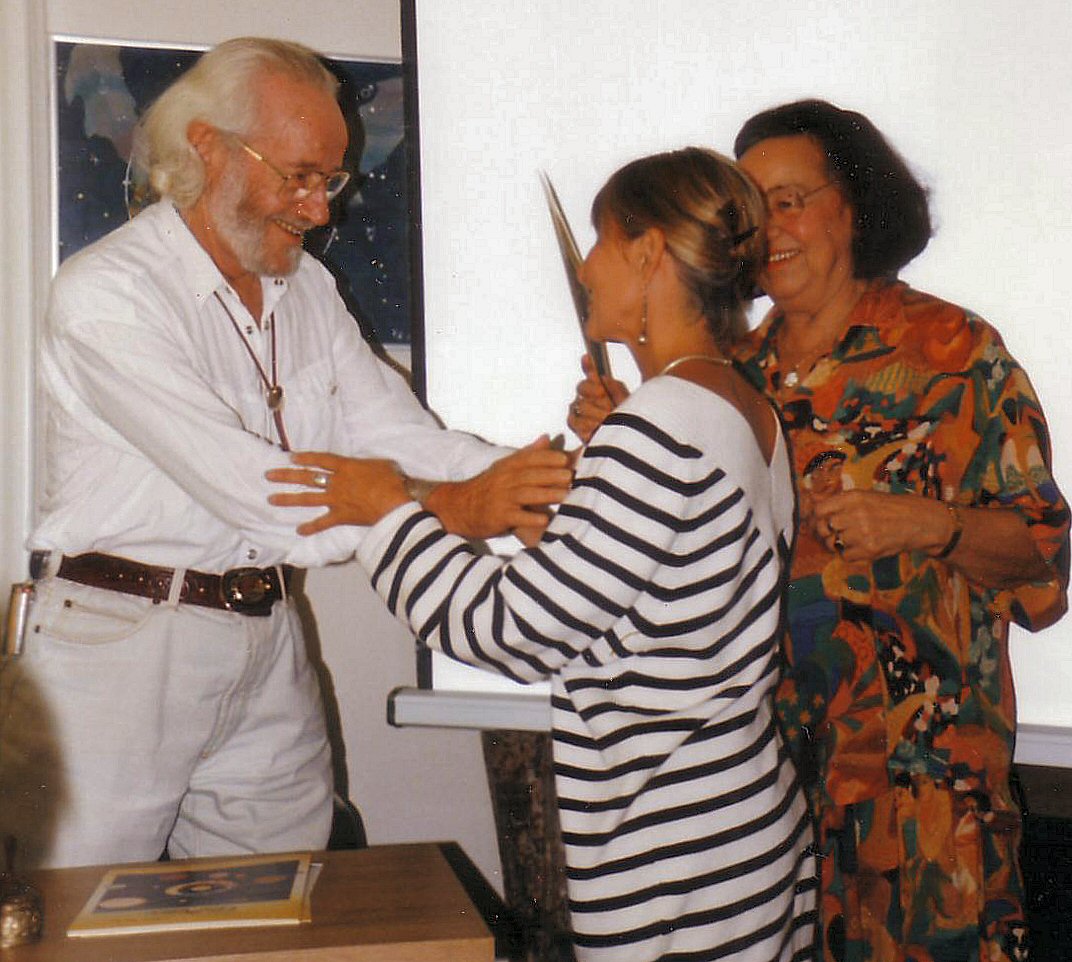
Bruno and Louise presenting an English Huber School student with her Diploma in Astrological Psychology

Since then, their well-researched approach, teaching and books on what is now known as The Huber Method, is used in many countries around the world. It focusses on personal and spiritual growth and on moving us as participating humans, into living our lives as kinder, and more aware people.
 
So why is the title of the book "Piercing the Eggshell"
 
Bruno Huber often likened a personal spiritual awakening to that sudden "aha" moment as when a chick emerges from it's shell, pokes it's head up into the world around it and sees that it is a whole lot bigger than the world it has been used to inside the shell. In the same way, we can metaphorically pierce our own eggshell and expand our awareness and capacity for growth. This is described more fully on p.84 of the book, along with a description of Bruno's Amphora Model, shown on the front cover.
 
"The shell represents the mental arguments we have to protect us but the impetus to break out comes from within as our spirituality is awakened. When this happens we leave the realms of normal consciousness and reach for answers 'out there' beyond our normal range. It means taking risks, but it's a movement of mind and consciousness." (book extract, p. 85)

You don’t need to know any astrology to enjoy the book as it’s an intriguing stand-alone read, but if you do understand some astrology you’ll probably get a lot more from it – and if you don’t know any astrology it might inspire to find out more. The photos and the few charts it contains are all in full colour, and there are many personal accounts and memories of Bruno and Louise contributed by students who knew them and worked with them, myself included.

Piercing the Eggshell is available from all good booksellers and from Amazon, as well as being available as an e-book. Click on the link for full details.

But best of all, go read it and be impressed – not that we wrote it – but by what these two remarkable people did and what their gift to humanity is.

Bruno and Louise Huber - two remarkable people

Also see more info on this book, which has been translated into German and Spanish, here and here, and has been favourably reviewed by an non-astrologer:

Fascinating Biography 
"Piercing the Eggshell" reviewed by Will Parfitt, Psychosynthesis therapist and author.

If you are an astrologer I would think this book is a must, even if you don't follow the Huber style of astrology; the story of how the Hubers created this new, very workable approach is interesting even to a non-astrologer like myself. 

Better still, for astrologers and non-astrologers, this is a tale of two people's indomitable will to create a new psychological science using astrological connections to include and raise consciousness to a deeper spiritual connection. A fascinating and most unusual biography, very interestingly illustrated with relevant photos.

I was particularly interested in the influence of Roberto Assagioli and Psychosynthesis on their work and the development of Huber astrology, and how whilst he fully supported them in their explorations, even giving Bruno Huber access to all his client notes, they worked hard to collate, edit and where necessary translate his writings into what became the key work in the Psychosynthesis world. 


2 Mar 2024

Never "too old"

 "I'm too old for that". If you've ever said that, or had someone tell you that you were "too old" for something, I hope your inner rebel came out and disagreed!


It's the kind of thing people say when encouraged to do something new or outrageously different, go somewhere new, dress in an uncharacteristic way, or behave in a manner which might be out of their normal range or comfort zone.......you get the gist. It's an "Act your age" thing. It's about risk - doing something different - and age appropriateness, along with the expectations of others in your immediate circle, or in the social setting you find yourself in.

What has this to do with astrological psychology and Age Progression? In truth, quite a lot. It depends on where you are, what "time" it is on your individual LifeClock and what psychological life phase you're moving through.

A couple of recent real life examples come to mind. The first is of the two 14 year-old girls I talked to about Hallowe'en last year, asking if they were going to dress up and go trick or treating. At 14, both are, by Age Point, astrologically in the 3rd house/area of life experience. Between the ages of 12 and 18, the focus is on puberty and growing up, and peer groups and friends take precedence over family; it's important to conform, fit in and be connected to current trends and events, especially at this stage of life when young people are feeling their way and finding the peer group where they belong. My expectations were that they could, by this age, be past the Hallowe'en ritual, but I was wrong. 

Being into their teenage years, fashion, make up etc. they were going for it big time. One of them said she was going to dress as Super Mario even though she was nearly 15. The other one dressed herself glamourously as a witch with a dark draped costume over black leggings, topped off with a large witches hat. Both wanted to be in on the fun of dressing up and were going trick and treating with friends. Rather than be "too old" to dress up and enjoy the annual trick and treating sugar-fest, they were actively embracing the opportunity to - in this case - act their age.

A few days later I watched a film made in 2015 of a meeting between the Dalai Lama and Archibishop Desmond Tutu. It was simply entitled "Joy" and watching it gave me 45 minutes of pure happiness and joy seeing these two men, both in their 80s at the time of filming, laughing and expressing their joy in life. Like two small boys they held hands, hugged, giggled, and shared insights and views on life and their respective faiths, all interspersed with much laughter, gentle teasing, love and respect for each other.

The Age Point of both men, when this film was made, was in the 2nd house, relating to ages 6 -12 years, where collected treasures and possessions are important and the child soaks up new information. Both men had been there before and this time, as seniors and Elders, they were revisiting this area of life experience, but for the second time around. With maturity, wisdom and life experience to draw upon, they were at home and comfortable being exactly who and what they were. Rather than possessively hanging on to things, they had been able to let go of all expectations regarding what they "should" be like and were at ease being just themselves, in the moment. They had no need to hold on to anything and "act their age", because they were doing so from a higher turn of the spiral, backed up by wisdom accrued along the way.

Both had found their personal style in life. Both had inner peace, expressed love, acceptance and kindness towards others, together with a strong spirtual outlook on life.This second circuit of the circle enables us, in later years, to revisit the energies, optimism and outlook of our younger selves, but on a higher turn of the spiral as we move away from being what others expect of us and towards who and what we truly are.

The Second Time Around, the title of my co-authored book with Barry Hopewell, covers Age Point experiences of real people who, like me, are on the second circuit of the LifeClock.

22 Aug 2022

Aspect Patterns and Astrological Psychology

Chart with Small Talent triangle, Streamer figure, Large Learning triangle


Aspect Patterns, as used in Astrological Psychology and the Huber Method, are pretty much the most revealing thing to consider in a chart when it comes to wanting to understand how people tick. There are 40+ recognisable aspect patterns, all of which relate to observable behaviour in others, and behaviour traits we can recognise in ourselves.

I've written about all of them in my book, Aspect Patterns in Colour, and each aspect pattern is discussed in the context of an example chart, mostly of a well-known person. You will find the charts of Bill Gates, Clint Eastwood, Meryl Streep, Helen Mirren, Charles Darwin, Elton John and Nelson Mandela all featured, to mention just a few.


Here's a small selection of aspect patterns, all of which I've written about in this resource website, once again using the charts of well-known people to illustrate them and the various motivations they suggest.


The shaping - triangular or quadrilateral - of the aspect pattern is significant as well as the colours of the aspects: red/blue/green.

 
Click on Aspect Patterns in the labels cloud on the sidebar on the left, and that will take you to a choice of no less 80 different blog posts where aspect patterns are featured in the charts or events I've written about.
For a detailed analysis of aspect patterns, the classic reference book is the one by Bruno and Louise Huber, to whom I dedicate my own book on this subject.  
 
Aspect Pattern Astrology was researched and developed by them at the Astrological Psychology Institute in Zurich, Switzerland, and it was here that I learned, first hand from them, so much about aspect patterns and the motivations they represent in the charts of individuals. 
 
Both books are available from Amazon. Full descriptions of both are on the  Astrological  Psychology website:


30 Jul 2022

The Moon's Nodes: what is your next step?


Where have you come from, where are now and where are you going?

Sometimes clients or non-astrologers will point to the glyph of the Moon’s North Node in the natal chart and ask “What does that thing like a headset with earphones mean?” This question offers an ideal opportunity for the astrologer to explain the significance of the nodal axis in the context of needing to “tune in and listen” to its message and bring greater awareness of what it indicates into everyday life.

The Moon's nodes are not planets and have no energy of their own. They are significant points in the chart and can be used as signposts pointing in two opposite directions. One points to an area of life experience and expression which is well-known and familiar. The other indicates where we could be heading on our own path of personal and spiritual growth - the "next step" point in the chart.

The message of the south node is “stay put, you’re safe here.” The message of the north node is “move forward and grow, even though it may feel scary.”

The nodes are best thought of as a nodal line, or axis - a path along which we can travel. Both ends of the line have to be included because the nodes can show us where we have come from. 

The nodes offer the potential for gaining balance within ourselves and our lives, and they can act as a correcting mechanism when we work cooperatively with them. Through a greater understanding of the nodes we can identify what we already know and have experienced and acquired in the past. 

We can do this from our stance in the present, where we are now, accepting our current situation together with all the challenges and opportunities it offers. At the same time, we can look towards the future and the direction we can take in order to grow, develop and unfold more fully. 


Í

The south node's position by sign and house indicates what we come into life already knowing well, what we are comfortable and familiar with, such our habitual responses, well-known and well-used habit patterns, ways of behaving, relating, responding and being. 

The south node has a Saturnian quality because it is about safety and familiarity. We may harbour doubts and fears about getting involved in new and challenging activities, and of stepping beyond the boundaries of our well-organised security system. The south node is like a cosy fur-lined rut or an old and comfortable pair of slippers that we’re loath to let go of – understandably so.

Ì

The north node leads the way into new and often uncharted territory. Its position by sign and house gives a clear message of what we can aim for as it shows the direction we can grow towards, if we so choose. 

It has a Jupiterian quality because it offers the opportunity to expand, open up and experience new things. It encourages us to move forward into areas which are less familiar and face the excitement and adventure of rising to new challenges in life. 

The north node in the chart is like a beacon indicating where and how we can develop ourselves through personal and spiritual growth. Following the direction of the north node may mean turning away from all that is safe, cosy and familiar as we move forward and break new ground. 

In astrological psychology, only the north node is included in the chart and the aspect structure. That's because the north node is considered to be an important feature for personal and spiritual growth, pointing the way forward to our next step along the path. 

The house/area of life experience will indicate where our next step might lie; the zodiac sign the north node is in will indicate how we behave and interact in that area of life. It will also give a nudge (if we take all of this on board) of what we might need to work on too!

As an example, actor Tom Hanks has the north node is in the 3rd house (comunication, learning, connected to community) and in the ruled-by-Jupiter sign of Sagittarius (being open to new things, expansion, taking risks etc).


There's much more about the  Moon's Nodes, 

and how to interpret and work with them, 

in my book The Living Birth Chart.


9 Jun 2022

Planetary manifestations


How do the energies and characteristics associated with the personal planets act out in everyday life? How is this energy expressed? We can observe it in human behaviour  - that of others and in our own responses to life situations.

Let's look at how it might show up, bearing in mind that the energies of the planets can operate at several different levels, ranging from downright low levels to more admirable and acceptable higher manifestations.

Starting with the Sun - our sense of self, which can always do with a polish up from time to time to keep it on the higher level - consider how you're feeling about yourself today, right now. Are you reasonably centred, focussed, clear in your mind about what you're doing? Are you willingly taking responsibility for yourself and the decisions you make?

Next check out the Moon. How are your feelings and emotions and needs? Is the small child in you acting up in any way? Can you give your feelings some attention or do you push them down, ignore them and hope they'll go away? Is there anything you can do right now to help with this?

What about Mercury? How are your communications with yourself (like the needy Moon)? And how are your communications with others? Are they good, clear, not muddled and well-expressed, or do you avoid straight talking? Do you pore over news websites to keep up with what's going on, or talk/WhatsApp a lot with friends? What are you reading or learning about right now?

Engaging with Venus, we can connect with the higher levels of beauty through the arts; on the lower levels we might just stuff ourselves full of food and become sluggish. Taking things up a few notches, we will be considerate to those around us, engage with our sense of taste in all areas of life, and strive for more harmony with our family and friends.

If we don't engage with Mars, nothing will get started and nothing will be achieved. Depends how you, and every individual, make the energies of this planet manifest. Argumentative, combative, controlling, bullying behaviour come across as pretty low down on this planet's possibilities but, directed skilfully and with awareness, it can be notched upwards and used as an impressive force to get things done, such as those small tasks we prefer to ignore and leave hanging around.

Jupiter is engaged when we step out of the ordinary and take a risk, and do something new or different, like eating a new dish, or going to a new place. We can all do something we've never done before, and it doesn't have to be outrageous (although Jupiter is not known for holding back as it's the master of grand gestures). You don't have to try bungee jumping, just temper whatever boundary of experience you want to extend with a little common sense, which takes us on to.....

Saturn who may be regarded by some as the killjoy of the cosmic group, but is essential to keep things within safe bounds on a personal as well as a general level. How do you structure your time, your day, your life? Saturn is on call here and fulfils the need we all have for stability and security - but keep this in perspective and don't let your saturnian tendencies hold you back. Proceed with caution and awareness and be thankful you have this capacity to keep yourself safe.

The Planets by Bruno and Louise Huber offers a lot more insight and info on these personal planets, and I recommend it as an excellent source of all you need to know to get you started on understanding how you and your planetary manifestations operate.