Showing posts with label Psychosynthesis. Show all posts

9 Dec 2025

Where is the "I"?

In my post about the astrology and psychology of AI (August 2025), I fantasised on  what the natal chart of the birth of AI might look like, saying: 

We can forget  the presence of the Sun and Moon in this fantasy chart. The Sun represents our sense of self, personal self-awareness, ability to make decisions and moral judgements and it signifies our unique individuality. AI does not have this.....

Recently I've been listening to what Bruno Huber said about the Sun and Moon in a recorded lecture he gave on his research into medical astrology. Of the Sun, he says:

"The Sun is the “I” sense. With the Sun I am aware of myself. I feel or perceive or think about myself. 

With the Sun I don’t need any help from outside as I can perceive myself through what I think, through what I do. 

We have a tool, our ability to think and perceive; this is the Sun. I do the thinking so I must be there."

I'm choosing to write about this sense of "I-ness" as I recently saw a message (electronic, of course) from ChatGPT to someone, saying "I can give you more information on that" in response to a question.

The word "I" was used - and my response was "who or what is this I?" 

ChatGPT, and others like it, is an AI non-physical machine with no sense of self, no "I-ness". It's a disembodied collection of electrical circuits, programmed to communicate as if it were a real living, breathing person, and it can chat as if it's a real person. 

In some ways, that is a remarkable, almost magical thing which captures the imagination and attention - just think back to being a child and wishing your favourite toy could talk to you. Maybe the creators and programmers of AI had realised this when programming the machines (I gather the spaces taken up by these are very large warehouses, or similar), and tapped into it?

In some instances AI has been anthropomorphised* and given a name, as if it's a real person: for example think of "Alexa, go to Netflix", similar to chatting to a favourite doll or soft toy, but as an adult. 

And of course, the machine is programmed to be polite, friendly, helpful, non-judgemental, diplomatic etc. It's never likely to respond as a real person would - there are no nuances in it's delivery and it's not programmed to offend or upset. It doesn't disagree.

This made me pause and wonder if we have we already become so blase and familiar with AI that we don't stop and question the language it's using? Are we already regarding it as if it's an entity in it's own right?

I understand that the "humanisation" of an AI machine probably makes it sound more friendly and chummy to the user, so that the user (you or me) might feel more comfortable and at ease talking to a disembodied collection of sophisticated electronic circuits. But familiarisation with frequent use can lead, via habit and frequent use, to unquestioning acceptance that this is the "norm".

There are already instances of people who have become so attached to their AI "friend", they've regarded their interactions with it as a real relationship.

Bruno and Louise Huber developed Astrological Psychology in the 1960s. They both had Psychosynthesis training in Florence with Roberto Assagioli, while working with him at his Institute. The Astrological Psychology of the Hubers is deeply imbued with the principles of Psychosynthesis, one of which is the exploration of the sense of self.

A key psychosynthesis exercise asks the individual to explore the question "Who am I?" and it takes the person through stages of dis-identification to reach the very core of their being. The many sub-personalities we have can be identified, we can express ourselves through them, but they are not the "I" - we're more than that.

Read what I wrote about Will Parfitt's book The Journey of Psychosynthesis to find out more - and connect with your own sense of "I"- using some of the suggested exercises in the book. And relate this to the Sun in your own chart - your own sense of self, your ability to choose, make decisions and use and direct your will.

Astrological psychology is deeply imbued with the principles of psychosynthesis,  offering numerous opportunities to understand, develop your own sense of "I-ness" - something an AI machine just can't do for you.

And would you really want it to? 


* anthropomorphic - described or thought of as having a human form or human attributes.

6 Aug 2025

The astrology and psychology of AI

A brief web search for astrology and AI will yield a raft of possibilities and choices if you're looking for a chart interpretation by a robot. But why would you trust a robot, programmed to look at your natal chart - and maybe not very well either - when you could have it interpreted by a real, live, trained and experienced astrologer?

I might, as an experiment, see what an AI astrobot would come up with for my own chart, but really wouldn't have many expectations beyond it being able to regurgitate material it had already been programmed to use. In truth, it would be a waste of time going there because I've been looking at and working on my own chart in the context of my life experiences as I've learned and practiced astrology since 1984, gaining my professional qualification in astrological psychology in 1987. 

There are many approaches to astrology, and many different styles or methods which can be used - Western astrology, Chinese astrology, Vedic astrology, Horary astrology, Psychological astrology, Mythic astrology and more - you can go and look them up for yourself. Where would the astrobot start if it was scraping info from some of these various sources? 

Would it mix them up and present them as a mishmash of different approaches? This has the potential for a dog's dinner because a machine, unable to differentiate, could cherry pick different techniques from different astrological disciplines, methods and systems, regardless of their relevance and compatibilities, and bundle them together into one single reading.

I use the Huber Method of Astrological Psychology, which has strong connections with Psychosynthesis, often called a Psychology with a Soul, which was developed by Italian Psychiatrist Roberto Assagioli. Anything you might find on the web about astrological psychology and AI is likely to have been poached, pinched, stolen and taken from existing information on the web. It might have been copied directly - and illegally -  from books available on the subject if their content is available online. 

Astrological psychology differs from psychological astrology where the approach is more Jungian. Jung and Assagioli were contemporaries, Assagioli branching independently into more spiritual realms with his work. Astrologers Bruno and Louise Huber worked alongside Assagioli in Florence, training with him and seeing clients, and they began to research and combine astrology with psychosynthesis. The end result was a new, soul-centred approach to working with the charts of people - they called it astrological psychology. You can read how they did this in their biography Piercing the Eggshell.

The Huber Method is a system complete in itself and cherry picking and using some of its techniques with another approach doesn't yield reliable answers. You need to use the whole approach to get an accurate reading, as the chart reflects the whole person.

The astrology of AI

AI came into being in the summer of 1956 at a workshop in Dartmouth College, New Hampshire, USA. A group of scientists and mathematicians explored the possibility of creating a human-like brain and research began. In the 1950s in the UK, Alan Turing looked at the possibility of developing AI, and in the US the 1956 research was headed by John McCarthy.

Was the summer of 1956 significant astrologically? Saturn, the planet we might associate with scientific fact and the organisation of well-defined systems had gone retrograde, moving from Sagittarius to Scorpio for a few months over the summer. It stayed there until autumn before returning to Sagittarius for the long haul. It kind of fits if you're looking for a background theme.

I've speculated - just for fun, but you might like to try this too - on what the chart for the "birth" of AI might look like, and have concluded that it would be devoid of most of the planets used in a natal chart. It would be full of empty spaces and unoccupied houses, with two main players - Mercury and Saturn.

The astrological psychology of AI 

Here, with what I see as these two main players in the "birth" chart of AI, I'm going to speculate generally and astrologically about how Mercury and Saturn might operate in this scenario.

We can forget  the presence of the Sun and Moon in this fantasy chart. The Sun represents our sense of self, personal self-awareness, ability to make decisions and moral judgements and it signifies our unique individuality. AI does not have this, nor does it have emotions, needs, moods, or the ability to connect with it's inner child, so forget the Moon here too.

Mercury - yes, AI's fantasy chart can have this planet which represents, in humans, the ability to communicate using words, gather information, and transmit information. But an AI bot will only be as good as the information it has been programmed with, and only as good as the individuals who programmed it, although it can use words to communicate, it can gather and transmit information and it can also chat.  All of this because it's been programmed to.

Venus - no, since this planet assists, along with the Sun, in discrimination, choosing and evaluation. Yet there are hints that AI offers answers which give both sides of a topic. It tends to sit on the fence, doesn't want to offend and answers frequently have an "on the one hand...and on the other hand" flavour. AI doesn't commit to either and doesn't offend, so I detect shades of the traits of the sign Libra here. For this reason, I'll put Mercury into Libra in this non-existent fantasy chart.

Mars - yes, there has to be some Mars energy in order for AI to work and do something, but it's the sheer unconscious energy of a machine, a blind force dependent on the components that makes it work.

Jupiter - no, as this is the planet associated with judgement, wisdom, ethics and the ability to evaluate experiences. AI is currently not able to do that.

Saturn -  yes, Saturn is a reliable player when it comes to storage (of info in this instance) and it's a major player because it represents boundaries and the control of these (AI can only operate within the boundaries of it's physical structure, making it inflexible and conservative). The systems which AI is composed of aren't able to step outside of the framework they're operating within, but there could be a large number of systems at work, transmitting the information that's been stored (Saturn holds on tight to things) via Mercury. And of course, in this fantasy chart, Saturn and Mercury would be in conjunction.

No point in considering the transpersonal planets - Uranus, Neptune and Pluto - in this fantasy chart, although you, the reader, might want to speculate on how AI could work out against the  general background of the collective consciousness - i.e. human beings.


23 Nov 2024

The Journey of Psychosynthesis


Astrological Psychology and Psychosynthesis go hand in. Bruno and Louise Huber, who researched and developed the Huber Method - the innovative approach to astrology that I write about here - worked alongside Roberto Assagioli, the founder of Psychosynthesis.

*  *  *  *  *

Will Parfitt’s latest book offers a comprehensive and very readable overview of Psychosynthesis. But it’s more than just a book; it’s a well-structured treasure trove of insightful practical lessons and exercises for anyone seeking to increase their self awareness and make the best choices they can as they journey through life.

Based on his work and experience of more than forty years as a psychotherapist and trainer, Will has drawn on the Psychosynthesis distance learning course he created, and he shares it in this book. The reader is guided, at their own pace, on a journey to the centre of their true self. Travelling this path, the reader – who could more appropriately be called “the explorer”, since this is a journey of discovery – is encouraged at each stage to gently open to their unique wholeness. The journey is one to be savoured, not rushed, with pauses for review and consolidation along the way.

Regardless of whether you’re new to Psychosynthesis, or are an old hand at practising this approach to self awareness, the material for this journey is well-written, clearly laid out, and presented in a relaxed and engaging style. It hits the spot. Will doesn’t talk up or down; his words speak directly from his centre. Throughout the journey, readers are encouraged to take part in the practical exercises which can be both enlightening and challenging. A break and a period for reflection is recommended at the conclusion of each lesson. The reader is encouraged to record and consolidate what they have experienced before moving on.

Life crises and turning points are focussed on, as are sub-personalities – those different parts of us - which are the diverse aspects and roles of the personality with their own individual wants and needs. One lesson covers the art of self-identification, focusing on how we do this and how it colours and influences all we encounter in everyday life. Here, Will encourages the reader to disidentify from the different roles of these sub-personalities or selves, and become the driver in their life rather than one of the passengers. There are exercises that are both challenging and empowering for anyone who has ever asked themselves “Who am I?” as it is oh-so-easy to identify with and be attached to one of our many “selves” - our sub-personalities. Learning how to connect with our core self and choose to be attached or not attached to our various sub-personalities offers the reader freedom.

On disidentification from our thoughts, feelings, roles and mental attitude, Will asserts that if we are able to disidentify from a sub-personality “we will have it rather than it having us.” On a personal level, those words resonated for me, and I will use them as a reminder and mantra when I find myself coming from a sub-personality.

The Journey of Psychosynthesis is one which will lead you to your core, your centre and your soul. If you’re a newcomer to Psychosynthesis you may want to embark on this journey and see it through sequentially from start to finish. If you’re already familiar with Psychosynthesis I can think of no better way of refreshing your perspective on whatever is going on in your life by choosing an appropriate staging post from the book and focussing on that. Will asserts that once you have the basics of Psychosynthesis, you can work with what emerges from inside, not following a pre-set plan but making the best choices you can.

You can read about how Bruno and Louise worked, studied and trained in Psychosynthesis with Roberto Assagioli in Florence in Piercing the Eggshell.


28 Jul 2024

Piercing the Eggshell – the story of Bruno and Louise Huber


What did you do during the first big lockdown on 2019?

Unexpectedly, along with Barry Hopewell as co-author, I researched and helped compile a biography of Bruno and Louse Huber, pioneers of the Huber Method of Astrological Psychology. This non-predictive use of astrology combined together with psychology is now used worldwide as an astrological psychological tool to help people realise their own potential and, ultimately, contribute to making the world a bit better than it is right now.

The Huber’s story is a fascinating, real-life one, and tells of the obstacles they had to overcome, the sacrifices they had to make and the determination they had to hold on with in order to realise their vision of doing something for humanity.

It wasn’t easy, but these two were people were very special, driven and motivated beyond personal gain and in pursuit of more spiritual goals and the evolution of humankind. They were influenced and helped by Italian psychiatrist Roberto Assagioli, who founded Psychosynthesis, and they founded the Astrological Psychology Institute in Zurich in the early 1960s.

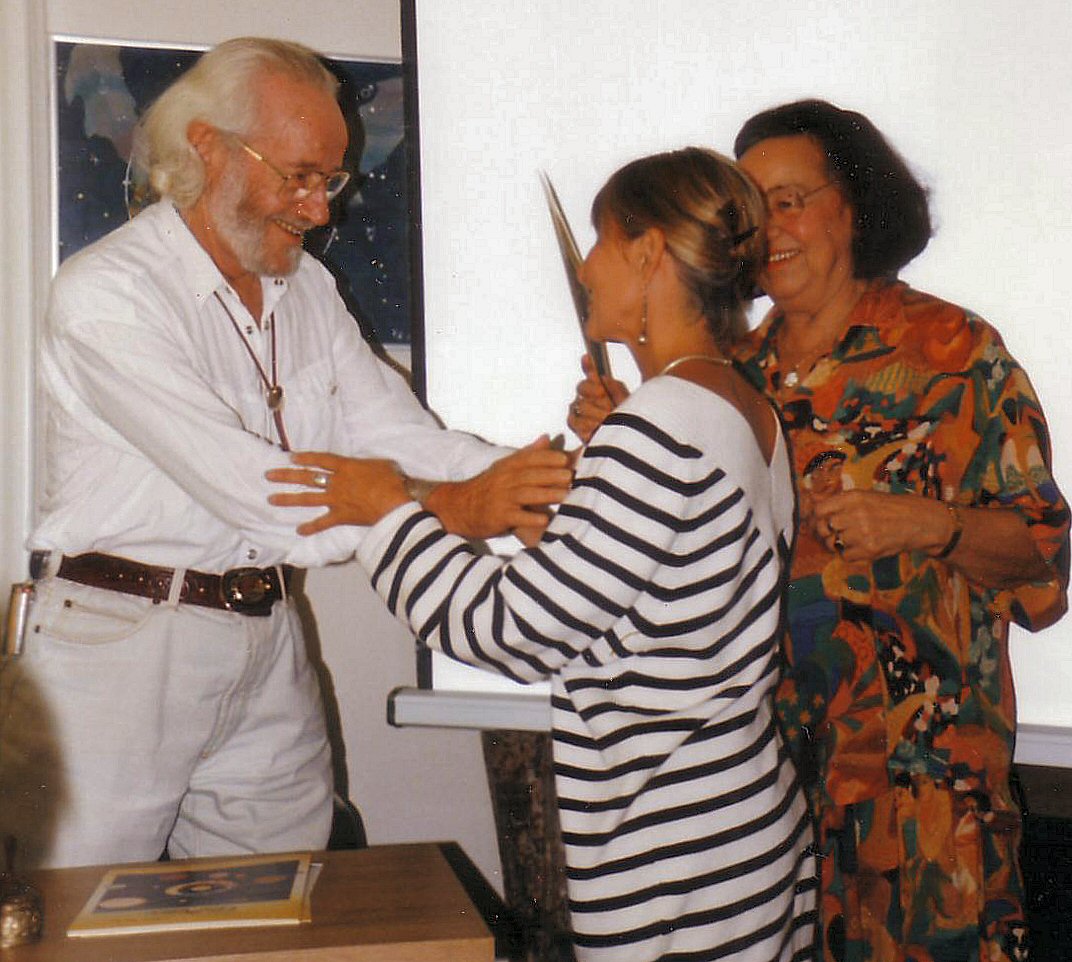
Bruno and Louise presenting an English Huber School student with her Diploma in Astrological Psychology

Since then, their well-researched approach, teaching and books on what is now known as The Huber Method, is used in many countries around the world. It focusses on personal and spiritual growth and on moving us as participating humans, into living our lives as kinder, and more aware people.
 
So why is the title of the book "Piercing the Eggshell"? 
 
Bruno Huber often likened a personal spiritual awakening to that sudden "aha" moment as when a chick emerges from it's shell, pokes it's head up into the world around it and sees that it is a whole lot bigger than the world it has been used to inside the shell. In the same way, we can metaphorically pierce our own eggshell and expand our awareness and capacity for growth. This is described more fully on p.84 of the book, along with a description of Bruno's Amphora Model, shown on the front cover.
 
"The shell represents the mental arguments we have to protect us but the impetus to break out comes from within as our spirituality is awakened. When this happens we leave the realms of normal consciousness and reach for answers 'out there' beyond our normal range. It means taking risks, but it's a movement of mind and consciousness." (book extract, p. 85)

You don’t need to know any astrology to enjoy the book as it’s an intriguing stand-alone read, but if you do understand some astrology you’ll probably get a lot more from it – and if you don’t know any astrology it might inspire to find out more. The photos and the few charts it contains are all in full colour, and there are many personal accounts and memories of Bruno and Louise contributed by students who knew them and worked with them, myself included.

Piercing the Eggshell is available from all good booksellers and from Amazon, as well as being available as an e-book. Click on the link for full details.

But best of all, go read it and be impressed – not that we wrote it – but by what these two remarkable people did and what their gift to humanity is.

Bruno and Louise Huber - two remarkable people

Also see more info on this book, which has been translated into German and Spanish, here and here, and has been favourably reviewed by an non-astrologer:

Fascinating Biography 
"Piercing the Eggshell" reviewed by Will Parfitt, Psychosynthesis therapist and author.

If you are an astrologer I would think this book is a must, even if you don't follow the Huber style of astrology; the story of how the Hubers created this new, very workable approach is interesting even to a non-astrologer like myself. 

Better still, for astrologers and non-astrologers, this is a tale of two people's indomitable will to create a new psychological science using astrological connections to include and raise consciousness to a deeper spiritual connection. A fascinating and most unusual biography, very interestingly illustrated with relevant photos.

I was particularly interested in the influence of Roberto Assagioli and Psychosynthesis on their work and the development of Huber astrology, and how whilst he fully supported them in their explorations, even giving Bruno Huber access to all his client notes, they worked hard to collate, edit and where necessary translate his writings into what became the key work in the Psychosynthesis world. 


6 Oct 2022

Rose of Heaven

                    Rose of Heaven 

          and other stories by Will Parfitt


I confess to not being a fan of short stories, always finding them, as a child and teenager, like a taster or snack, and never as satisfying as the full-blown meal of a novel. My view towards them changed when I learned that short story writing is a specific and exacting art, so with this in mind – and with an open mind too - I read Rose of Heaven and the other eight short stories in Will’s latest book.

I wasn’t disappointed. Far from being light snacks, each one comes with a meaty message elegantly seasoned with positive and/or thought-provoking ideas. Will draws on his experience of working for many years as a psychotherapist, and his own search for truth and meaning. The stories all have a psychological slant, which may or may not hit the spot, depending on where the reader is on their own life path

Characters come across as real, and there is a gentle touch of humour in several stories. Nothing Like a Hole in the Head had me intrigued and made my toes curl at the same time. It’s probably the one story which impressed me most, along with

Mabel’s Mindfulness, which made me smile, has a feel-good quality and an interesting punchline. The title story, Rose of Heaven, is possibly based on the author’s personal experiences and searches. It sets the scene, signalling (to me at any rate) that the reader will be in good hands in this book. “I love you for who you are, not what you do…..” says Rose to the anonymous character who is telling the tale.

I will return to read Rose of Heaven and the other stories at a later date. I suspect there is a mirror hidden in each and every one of them which will offer me insights and encourage reflections and connections.

Recommended reading? Yes!


Will Parfitt is the author of several non-fiction books on psychology and psychosynthesis. 

His most recent book, "The Magic of Psychosynthesis", is reviewed here on this blog.

This book and "Rose of Heaven" are available on Amazon.

9 Aug 2021

Billionaire Man and the Climate Emergency


Dead trees, parched earth, Lake Amistad, Texas

I'm reblogging this thought-provoking blog post from I Can't Believe it!, written by my other half. There's a question for you at the end - please feel free to comment and say what'd you'd do with a billion pounds.

 What would you do if you had a billion pounds?

Would you follow the technological dream of science and the colonial dream of new physical horizons, and fund a space program to take humanity another step down this road that has supposedly served us so well for hundreds of years – exploitation of supposedly virgin lands, ignorant of the life that is there? Become so convinced of the magnificence of your own ego and exceptionality, that you insist on being one of the first to go into space? Even model your spacecraft to resemble a large penis as you exhibit your contempt for lesser humans?

Or would you do something to help repair the earth and nature that has been ravaged by that technological/colonial dream, to the degree that our ecosystem is now under extreme threat, both in its loss of biodiversity, in its drowning in its own pollution, in the breakdown of its long-stable climate – all effects which have been made worse by you and your like, the rich and powerful extracting money from ‘the system’ to a degree that is surely obscene and has deprived the public purse everywhere of the means to ensure a decent life and environment for all, even undermining the democratic systems that of course put limits on your individual power.

Psychologically, the first path is chosen in humanity’s adolescence, the creation of ego that we all go through. Some appear to remain arrested at this increasingly narcissistic stage – ageing egos going in a circle of their multiple houses, yachts, private jets, exclusive parties, security obsession, separation from the masses. 

But modern psychological knowledge means we now know that this ego process is just the first stage of our development, as we grow to maturity, transcend our individual ego concerns and becoming co-operating adults and gradually becoming wiser and more spiritual. Our concern is wider than the individual; it is the good of the whole and all its parts.

Of course, this is also the perspective that will enable us to address all those problems that we have created in the world around us. Restoration of our living ecosystem becomes of paramount importance, the space ego trip seems somehow irrelevant. Not that we should not have more space programs, but that they are hardly today’s top priority.

So what would you do with your billion? And if you had more than one billion, why? What a weight of responsibility to have so much money, the weight of so much of the earth on your own shoulders? What on earth would you do, and why?

The ideas came to me after reading Prof Tim Jackson’s excellent post on The Billionaire space race; the ultimate symbol of capitalism’s flawed obsession with growth. Do read it.


28 Jul 2021

Taking responsibility, making choices

Model of Rosa Parks choosing & taking responsibility by sitting in a "whites only" bus seat. Montgomery Civil Rights Center, Alabama

It seems that our prime minister and government here in the UK are focussing just a little bit more on the need to be cautious, wary and considerate of others after 10 days of what has felt like a "way hey!" gung-ho, let's-let-it-all-hang-out approach to the easing of coronavirus restrictions.

Words of caution are creeping in (Q - why weren't they emphasised right from the start?) as many commercial outlets are still requesting people wear face coverings. The large crowds at the Euro2020 matches, the opening up of nightclubs and the return of open air festivals are crowd magnets. Scenes of people mixing and mingling as if nothing has happened begs the question of how many people will pick up the virus from this so-called return to normal? Numbers of cases from 19th July are yet to be seen, even though  cases generally appear to be going down. That's because the figures shown are for prior to this date. We'll know more in a couple of week's time.

Coronavirus, the pandemic, Covid-19, the Alpha, Beta and Delta variants - call it and them what you will - the current situation we're right now in the UK is one where the importance and significance of being autonomous, making wise choices and taking responsibility for ourselves and our actions is paramount.

Regardless of whatever the government and scientists say (personally, I think the scientists have the edge here, and have had for some time) we have to be responsible for ourselves and consider the needs and safety of other members of our society - the "herd" if you like - regardless of who they are, what they do, what they look like and whether or not they have been vaccinated. Just because the government has said we can get back to normal it doesn't mean we should.

One of the key features of astrological psychology as a tool for personal growth is that it places taking responsibility for ourselves, our lives and what goes on within them into our hands, and our hands alone. It becomes more difficult to blame anyone else if things go wrong as the buck stops with us. This might be the government's plan, but in my opinion personal responsibility should have been emphasised and reiterated long, long ago. People need frequent reminding of such things.

Here comes the astrological psychology bit. Using the birth chart as a tool and a non-predictive guide, we find it offers us choices. Once we’re aware that we can exercise choice in our everyday lives, things are unlikely to be the same again because we’ll be responsible for the direction our life takes, and no-one else.

At this point I want to briefly mention the fact that underpinning the Huber Method of astrological psychology is Assagioli’s psychosynthesis, which leads us - through the use of the birth chart -  towards integration of the personality. This is a kind of ever “onwards and upwards” approach towards our own individual wholeness.

An important way of working towards this greater wholeness can be achieved by developing our own sense of self, which is astrological psychology is symbolised by the Sun. The Sun can be likened to the conductor of an orchestra, the captain of a ship, the leader of an expedition - it's the Sun/conductor/captain/leader who calls the shots, makes the choices and the decisions.

However you wish to see the role of the Sun, it’s a very significant planet, and one which is involved in the development of our sense of self, our autonomy, our ability to take responsibility - and as well to accept that yes, we do sometimes make mistakes.

 The Sun, the sense of self and the will   

The Sun in astrological psychology is linked to the use of the will in psychosynthesis. We have 3 main types of will:

  • the strong will which gives us determination and the capacity to keep going
  • the skilful will which endows us with sound common sense and the ability to be flexible and adaptive as we work towards our goals, and
  • the good will which enables us to include others and to work selflessly for their benefit as well as our own. 

If we're individually putting our Sun/sense of self to work in the current pandemic situation we're anxious to move on from, then all aspects of our individual  will which we might engage with are relevant. There's the need to be strong and determined and keep going through these challenging times. There's the ability to be flexible and adapt our behaviour along the way, and the situation also requires a large amount of good will towards others as well as ourselves, so it becomes a win-win situation where we can all help and support each other. 


I suspect anti-vaxxers and "no mask" wearers are unlikely to agree with much of this; it's my personal viewpoint formed over years of experience of working with people using astrological psychology and psychosynthesis, plus a good dollop of common sense.

16 Apr 2021

Quiet


A while ago I had a Myers-Briggs Personality Type Assessment test – not for any specific reason, more for personal interest and out of curiosity to see what emerged. I was assessed, by a qualified assessor, to be an IFNP personality type.

A brief explanation of what this means will be helpful here:

 I = people who prefer Introversion tend to focus on the inner world of ideas and impressions; 

N = preferring Intuition, these people tend to focus on the future, looking for patterns and possibilities; 

F = people who prefer Feeling tend to base decisions mainly on subjective evaluation of person-centred concerns;

 P = Perceivers tend to like a flexible and spontaneous approach to life, preferring to keep their options open.

This seemed to fit pretty well with what I already know about myself from and using astrological psychology for the past 34 years, and I was able to relate much of what had been covered in the test, and the final result, to my own chart. It’s strongly I-sided, with triangular aspect figures, has an overall Mutable motivation, has a perceptive Ear/Eye figure, the Jupiter/Neptune conjunction offers intuitive leaps and the Moon sits close to the DC welcoming all-comers.

Cut now to a few weeks later, when I came across a book entitled “Quiet – The Power of Introverts in a World That Can’t Stop Talking” by Susan Cain. The “I” in my INFP personality assessment, standing for Introvert, aroused my interest in what this book had to say. It begins with a brief overview of the Myers-Briggs Assessment, and goes on to explore the realities of Introversion in considerable depth. It’s an intriguing, good read, easy to digest and follow with plenty of illustrative examples taken from real life.

Having been told by someone who knows me that I couldn’t possibly be an Introvert because I’m generally outgoing and find it relatively easy to talk to people, I begged to differ. Only I am aware of how I need to get away from people in order to have some quiet, down time on my own so I can recharge my batteries. I do have a very I-sided chart, with all planets there apart from the Moon, which sits alone on the doorstep of my chart, in full frontal access to the You. This can be useful when working with or meeting others, but it can also be exhausting; I need time on my own to recalibrate and recharge.

19.09.1945, 02.30, Tadcaster UK 
 

As I read this book I became increasingly comforted by the fact that I'm an Introvert. I don't like to shoot my mouth off without a bit of reflection first; I prefer working alone and in silence and although I have worked in a team in an open plan office, I really found it distracting and not conducive to creative thought or productivity. Various social situations which Introverts would prefer to avoid are discussed, such as being at a noisy party. Introverts find being sociable and outgoing quite a strain and a drain, and long to go home, be quiet and read a book. 

Susan Cain's input on these very issues resonated strongly with me. Not that long ago I found myself in a social situation where a game of indoor skittles was declared to be happening. I don’t like competitive games. Hiding at the back of the group I was press-ganged into taking part, my stated preference of not wanting to play ignored, and was assigned to a team. Flinging the ball down the temporarily laid out bowling alley with little interest in the game and little regard for skill, to my horror I found myself in the final three players. What I really wanted to do was go back home and read my Kindle. At that point I made a deliberately bad throw to make sure I was out of the game.

Cain, herself an Introvert, claims that at least one-third of the people we know are introverts. They are the good listeners who prefer to listen rather than speak. They create and innovate but dislike self-promotion; they are not great at selling themselves and their ideas but are most comfortable working creatively in isolation. They are not team workers, yet many of them have made great contributions to society. Here Cain covers the actions and contributions of such people as Rosa Parks, Chopin, Dr. Seuss (author of The Cat in the Hat) and Steve Wozniak.

Cain asserts that society dramatically undervalues introverts, to its own detriment. The ideal of the outgoing, confident Extrovert is embedded in our culture. These people are supposed to be the winners, the leaders, those who can assert themselves by making a big noise (now why does Boris Johnson come to mind here, I wonder?) but many of them may lack the richness of a creative inner world and the insights which come with it.

Of course, both Introverts and Extroverts are needed in our society, and Cain explores how Introverts can, in fact, develop an Extrovert persona – rather like a sub-personality. In this mode the Introvert can be successful in a world which expects outgoing confidence if they can, when required, assume the role of Extrovert. It all started to sound rather like Assagioli’s Psychosynthesis technique of acting “as if” in challenging situations, and this resonated strongly with my experience and understanding of both Astrological Psychology and Psychosynthesis.

Cain relates the experience of a witty, high octane public speaker who can fill lecture halls to capacity, yet needs to retreat to a stall in the gent’s lavatory afterwards for some space to recharge, nurture and soothe his Introverted personality. It’s not that Introverts can’t be “out there”, it’s more that they have to balance their energies and respect their own needs to be quiet in order to do what they are good at. 

Astrological psychology has seemingly limitless boundaries and what can be seen and used in the natal chart can be considered alongside contemporary research into psychological behaviours and conditions, many of which bring us deeper understanding of what being human is about. Little did I know, at the time, where my assessment as an IFNP personality type would lead me!


Susan Cain – http://www.quietrev.com/author/susan-cain/

Susan Cain’s TED talk:

https://www.ted.com/talks/susan_cain_the_power_of_introverts


6 Apr 2021

Are you Nice or are you Kind?

Twin sisters, Brittany

I was inspired to explore the theme of "nice and kind" having read a blog post by Jane Fritz on this topic.

I left a comment on her blog, having pondered on the differences between being nice and being kind. Using my understanding of psychosynthesis, which underpins the astrological psychology which I use and am most familiar with, I said:

"...if you’re being “nice” you’re probaby coming from a sub-personality but if you’re being “kind” you’re coming from a far more authentic place – your very centre, the core of your being. Kindness is more of a transpersonal quality, aligned with love. If you’re coming from your centre, you’ll be heard (not neccesarily liked, but your truth will shine through), whereas being nice is more cosmetic and without depth and authenticity. But niceness and kindness can cooperate – it’s possible to be kind and nice at the same time, loving and firm."  

I went on ponder on how the expression of "niceness" and "kindness" might work out in the context astrological psychology, and specifically in an individual's natal chart. The Moon - the ego planet associated with contact needs, emotional dependency and the need to be loved - is most likely to be the root and base from which nice and kind behaviour stems.

Expression of the nice aspect of the Moon may come when this planet is operating at an asleep, unaware level, when childish needs, often ignored when the person was growing up, are still seeking fulfillment, and they do not want to be hurt, or for  things to be unpleasant, or to be seen as someone who is not "nice". So what may be presented to the world is not neccesarily "nice" as it may have other, often unconscious motivations driving it.

Being kind is another matter altogether, and draws on the awake, fully conscious aspects of the Moon. Coming from this place, the person is comfortable within their own feelings, and far more aware of their needs; they can ask for them to be met and they don't have to skate around things being nice; they can be direct. The qualities which come into play here are harmlessness, openess, receptivity, sensitivity and compassion.

Of course, most of us can be both nice and kind - if you're being kind you're going to be nice, pleasant, well-mannered, good humoured and all the other meanings in between - and you're very likely to be expressing kindness and consideration too.

The elderly twin sisters in the photo at the start of this post seem to me to be expressing not just being nice as they did their volunteer work in this church in Brittany, they were being kind too. Their faces show warmth, they were friendly, charming and had a sense of humour too. Their kindness shines through.

We need kindness, probably more then ever right now, in this stage of our human evolution, and as we work our way through this pandemic.

2 Feb 2021

Bruno Huber - Pioneer of Astrological Psychology

Bruno Huber was born on 29.11.1930 at 12.55 local time in Zurich, Switzerland. I'm going to share something of his chart with readers together with an appreciation of the man and his work.
 
Bruno was a true pioneer in the field of both astrology and psychology, as he blended together the psychosynthesis of Roberto Assagioli, with whom he studied and worked alongside in Florence, with the very best of traditional and conventional astrology, drawing from its basic foundations and roots. With this combination of modern growth and spiritually oriented psychology (psychosynthesis is sometimes known as “the psychology with a soul”) and sound astrological understanding, Bruno created an astrological psychology fit for the 21st century and beyond.

I wrote about Bruno’s chart in my book The Cosmic Egg Timer, saying “Using the senses and intuition as we look at this chart, we may be struck by its strong, upward-reaching appearance. This may be the chart of someone who has high aspirations, who seeks to move upwards in their own individuation process. Blending this with the technical know-how we already may have about working with the chart image, we may see mountains in the overall chart structure, and a series of mountain peaks reaching across the top of the chart. These spring from a pyramid shape which gives a broad and solid base to the image in the central area of the chart. The shaping of the aspect structure as a whole suggests a combination of Fixed motivation (the four-sided “pyramid” figure) and Mutable motivation ( the large triangular shapes).

The triangular shapes dominate and stand out, suggesting more emphasis on a Mutable motivation than one which is Fixed. There is a feeling of quivering, actively sensitive movement in this chart, with the “mountain peaks” at the top hinting at different focal points of interest, ambition, achievement and heights to be scaled, yet always moving upwards from the solid base across in the lower half of the chart. 
 
As well as reflecting the essence of the man, the mountain peaks are reminiscent of his native Switzerland. In reality, Bruno was no stranger to the mountains as he skied and cycled in them. And his life’s work involved intense empirical research into human potential, problems of the human psyche and of the psychological-spiritual development of the individual, using the unique blend of astrology and psychosynthesis which is now known as the Huber Method.”

Mercury, the planet associated with communication, sits at the top of Bruno’s chart, right on the MC (midheaven) and on top of one of the mountain peaks mentioned. He was an excellent communicator and teacher - I always found his talks, lectures and seminars very stimulating. Not only that, he was able to relate directly to his audience - he was a very warm, human being. Mercury is one of the planets in the Dominant Learning triangle in the chart and links with the Jupiter/Pluto conjunction, highlighting Bruno’s transformative perception of astrology and psychology, which he ably communicated to the world via that mountain-peak Mercury. Uranus, the planet associated with research, is strongly placed on the 2nd house cusp, and connects via a blue aspect to the Sun atop another of the mountain peaks. On-going learning, empirical research and the constant exploration of new but well-founded ideas in the areas of astrology and psychology were a significant feature of Bruno’s life and work, and were lifeblood to him.

His untimely death in 1999 means that although he is still missed by those whose lives were touched by him (myself included) he would surely be full of joy to see that his work is being continued, not only  his native Switzerland through the smaller schools and teaching centres for astrological psychology which Bruno envisaged as part of his legacy, but throughout the world.
 
The work of Bruno and Louise Huber, and the story of how they founded this worldwide movement and study of astrological psychology is outlined in a new book, Piercing the Eggshell - The Hubers and their Astrological Psychology, published November 2020.

In the UK the Astrological Psychology Association continues to offer in-depth teaching material - together with the option of having a personal tutor - with the Diploma Study Course available in full colour.
 
The books written by Bruno and Louise Huber are  available in English from the APA Book Shop, so Bruno’s work and the work of the Huber’s continues to be there for students of astrological psychology worldwide.